Surface Grinder vs Milling Machine: Which Holds It
A surface grinder removes microns and holds flatness; a milling machine removes millimetres. Which one your part needs, decided by tolerance and finish.
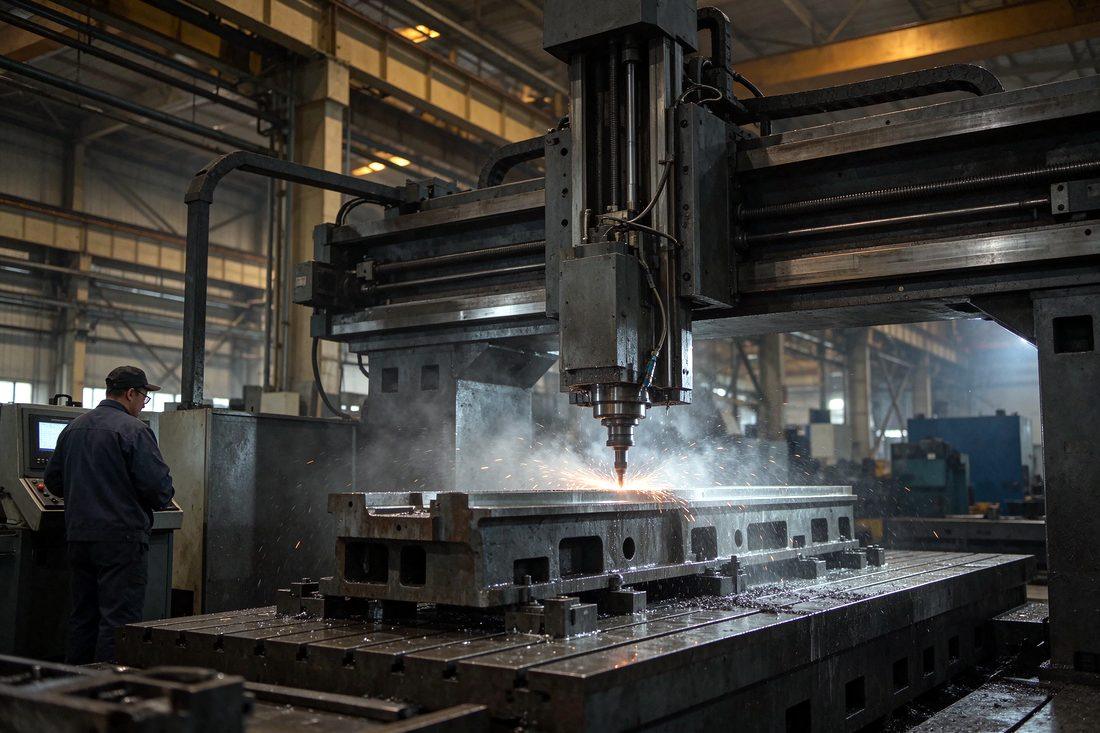
- Where each process actually wins
- The tolerance test that decides the process
- Hardened steel is the dividing line
- What a grinder costs to run against a mill
- When you need both, and in what order
- FAQ
- Can a milling machine replace a surface grinder?
- Which is more accurate, surface grinder or milling machine?
- Is grinding always slower than milling?
- Do I need a surface grinder if I already outsource grinding?
- Bottom line
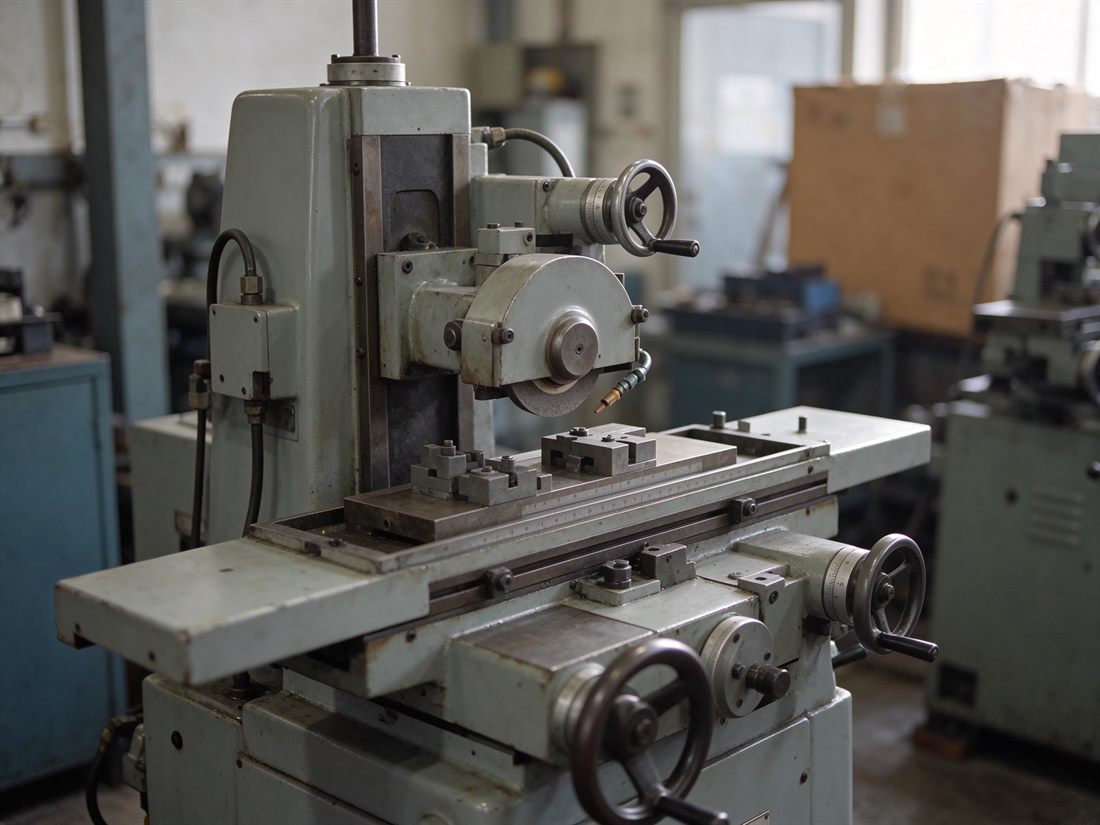
The difference between a surface grinder and a milling machine is the size of the chip, not the size of the machine. A surface grinder takes 0.005–0.05 mm per pass with an abrasive wheel and holds flatness to 0.005 mm and Ra to 0.4 µm. A milling machine takes 0.5–5 mm per pass with a cutting tool and holds 0.02–0.05 mm on a good VMC. When the drawing asks for flatness, parallelism or finish that a cutter cannot leave, the surface grinder is the second operation — not a competing machine.
Where each process actually wins
Milling is a volume-removal process. Its economy comes from taking material fast in one setup, with a tool that can be indexed and replaced. Its limits come from the tool geometry: every inserted cutter leaves a periodic pattern, and every cutter deflects under load, so the achievable flatness is bounded by machine rigidity and tool runout rather than by the operator's skill.
Grinding is an accuracy process. An abrasive wheel has thousands of cutting edges, each removing a chip measured in microns, so the force per edge is tiny and the deflection that limits milling disappears. That is why a 30-year-old surface grinder can hold a tolerance a new VMC cannot: the physics favours it.
| Dimension | Surface grinder | Milling machine (VMC) |
|---|---|---|
| Typical depth of cut per pass | 0.005–0.05 mm | 0.5–5 mm |
| Material removal rate | Low (grams per minute) | High (kilograms per hour) |
| Achievable flatness | 0.002–0.005 mm over 300 mm | 0.02–0.05 mm typical |
| Achievable surface finish | Ra 0.1–0.8 µm | Ra 0.8–3.2 µm |
| Effect on hardened steel | Grinds 58–65 HRC directly | Needs carbide or CBN, slower, tool wear high |
| Heat introduced | Low total, but concentrated — burn risk if rushed | High total, part distortion common |
| Setup for a flat face | Chuck, one clamp, repeatable | Vice or fixture, more variable |
The tolerance test that decides the process
Read the drawing before you read the machine list. Three callouts send the part to a grinder:
- Flatness under 0.01 mm on a face wider than 100 mm. Milling can approach it on a rigid machine with a fresh face mill, but not repeatably across a batch.
- Parallelism between two faces under 0.01 mm, especially on hardened parts, where milling after heat treatment is impractical.
- Surface finish Ra 0.4 µm or better, or any callout that specifies "no tool marks" or a sealing face for an O-ring or gasket.
Conversely, three situations make grinding the wrong choice: a feature that is not flat or round (grinding is geometry-specific), a part that needs 3 mm removed from a face (that is a day of grinding for an hour of milling), and a part with pockets or slots that a wheel cannot reach.
Hardened steel is the dividing line
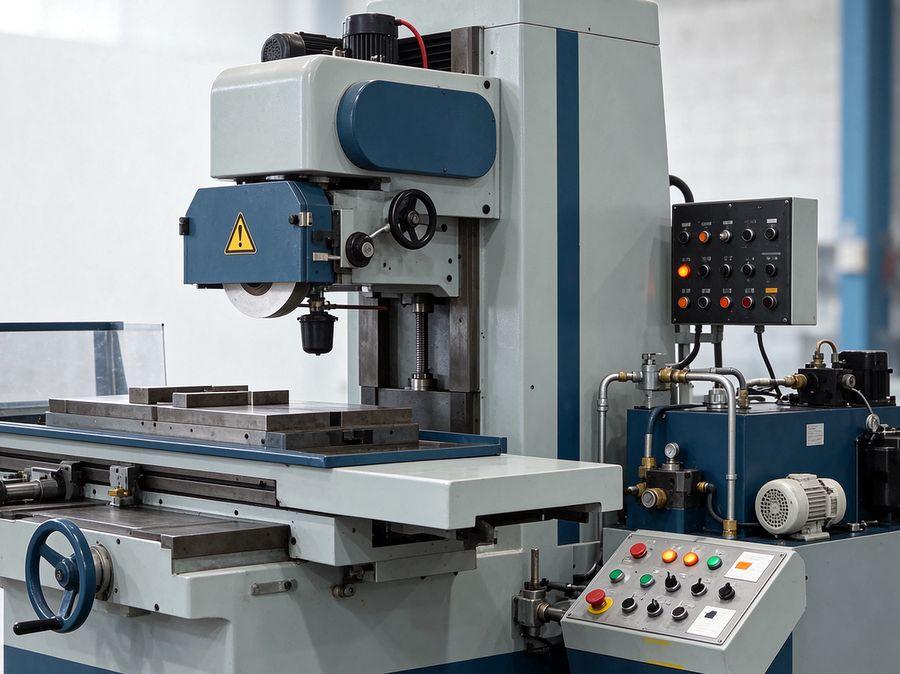
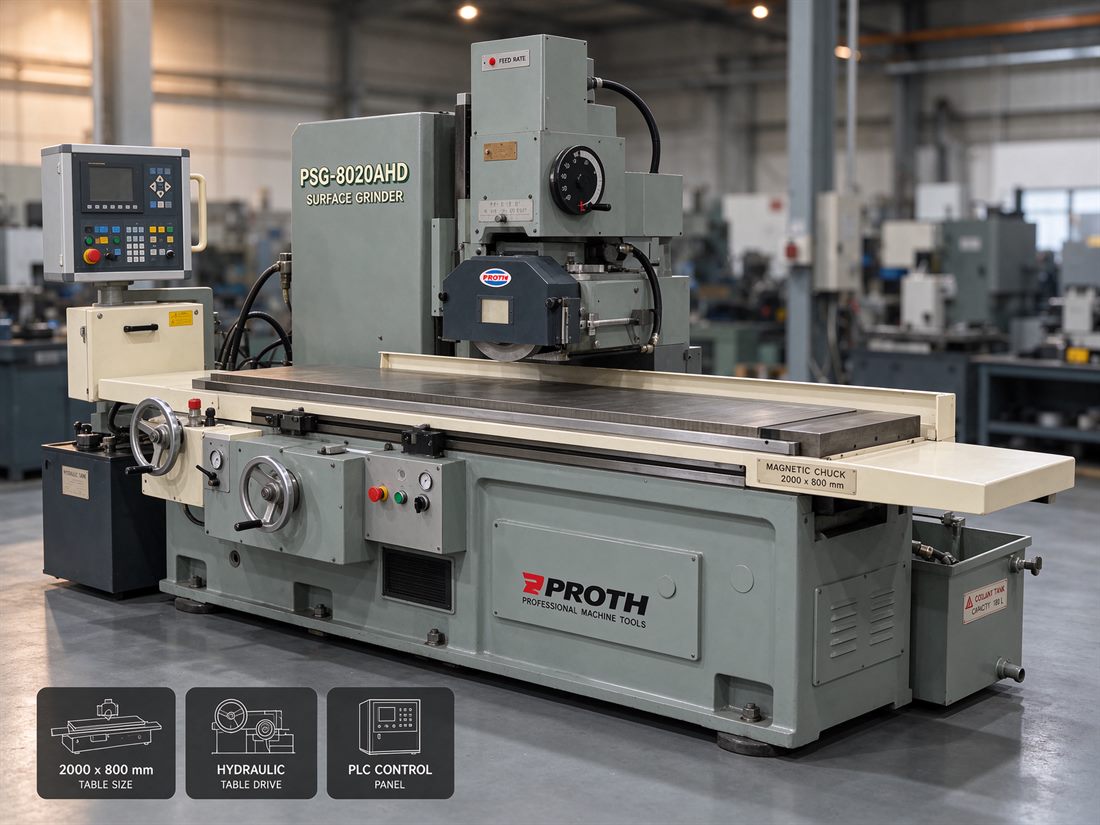
Once a part is through-hardened to 58 HRC, the arithmetic changes. Milling hardened steel is possible with CBN or ceramic inserts at low depth of cut, but the tool cost per part climbs and the process pushes heat into the part. Grinding hardened steel is the normal case, not the exception: an aluminium oxide wheel takes 0.02 mm per pass, the coolant carries the heat away, and the part stays at 30 °C. For die and mould work, the sequence is mill soft, heat treat, then grind the faces and the parting line — the PSG-250AH class of machine exists precisely to do that second step at production volume.
Where the part stays soft and the tolerance is loose, milling wins on cost every time. A 0.05 mm tolerance on a 200 mm plate does not need an abrasive process.
What a grinder costs to run against a mill
| Cost element | Surface grinder | VMC |
|---|---|---|
| Consumable | Wheel, USD 25–80, lasts 200–600 parts | Inserts, USD 60–200 per set, 50–300 parts |
| Cooling | Flood coolant, filtration matters | Flood or MQL |
| Operator skill | Medium — judgement on spark and sound | Medium to high for programming |
| Removal rate | 0.1–0.5 cm³/min | 50–300 cm³/min |
| Finishing pass needed after | None, if the finish callout is met | Often a second grinding operation |
The number that surprises buyers is the last row. A shop that mills a sealing face to 0.03 mm flatness and Ra 1.6 µm and then sends it out for grinding is paying twice for transport and setup. Keeping a surface grinder in-house for the finishing pass is usually cheaper than the outsourcing, once the monthly volume passes a few dozen parts.
The two processes are not rivals in the factory either: the bed of a surface grinder is milled first, then hand scraped to the flatness a cutter cannot reach.
When you need both, and in what order
Most precision parts see both machines. The rule that keeps scrap low is: remove everything a cutter can remove while the part is soft, then grind only the faces that carry a tolerance callout. Grinding stock that a mill could have removed is the classic waste — a 3 mm allowance on a 500 × 250 mm plate is roughly six hours of grinding and twenty minutes of milling.
A practical sequence for a hardened die plate: mill the pocket and outline, leave 0.3–0.5 mm on the faces to be ground, heat treat, then grind the faces with 0.02 mm passes. The 0.3 mm allowance is enough to clean up heat-treat distortion without turning the grinder into a roughing machine.
FAQ
Can a milling machine replace a surface grinder?
No. Milling can produce a flat face, but not a 0.005 mm flatness on hardened steel with Ra 0.4 µm, repeatably. It can replace grinding only where the tolerance is 0.02 mm or looser and the part is soft.
Which is more accurate, surface grinder or milling machine?
The surface grinder, by roughly an order of magnitude on flatness and finish. A VMC holds 0.02–0.05 mm flatness typically; a surface grinder holds 0.002–0.005 mm.
Is grinding always slower than milling?
Yes on removal rate, by 100 to 1,000 times. But grinding usually replaces three operations — mill, heat treat, finish — with one finishing pass, so total lead time often improves.
Do I need a surface grinder if I already outsource grinding?
Run the arithmetic on your monthly grinding invoice. Above roughly USD 1,500 per month, a manual machine such as the PSG-618M pays for itself inside a year, and you stop planning around a subcontractor's schedule.
Bottom line
Decide by the drawing, not by the machine you already own: flatness, parallelism, finish and hardness are the four callouts that send a part to a grinder. If you tell us the part size, the tolerance and the hardness, we will tell you which table size covers it and whether a manual, hydraulic or CNC feed makes sense for your volume. Send us the drawing.