Grinding Wheel RPM: Matching Speed to the Spindle
How grinding wheel RPM relates to surface speed, the m/s each wheel type wants, the diameter-to-RPM table, and what overspeeding a wheel actually does.

- Surface speed versus spindle RPM
- What each wheel type wants
- What overspeeding a wheel does
- Why the speed changes the finish, not just the rate
- Decreasing diameter as the wheel wears
- FAQ
- What RPM should a surface grinder spindle run?
- Can I run a smaller wheel faster to keep the same surface speed?
- What happens if I run a wheel below its rated speed?
- How do I know a wheel's maximum speed?
- Bottom line
Vitrified aluminium oxide wheels want a surface speed of 30–33 m/s; resin-bonded wheels 35–40 m/s; CBN and diamond wheels 40–60 m/s or more, depending on the bond. Spindle RPM is whatever turns a wheel of your diameter into that surface speed, so a 200 mm wheel needs about 3,000 rpm to reach 32 m/s, while a 150 mm wheel needs 4,000 rpm for the same speed. Every wheel carries a maximum speed marked on its blotter, and exceeding it is not a performance question — it is a burst risk.
Surface speed versus spindle RPM
The number that governs grinding behaviour is surface speed — how fast the abrasive passes the work, in metres per second. Spindle RPM is only a means to that end, and it changes every time you change wheel diameter.
The relation: surface speed (m/s) = π × diameter (m) × RPM / 60. Rearranged for what you actually set: RPM = 60 × surface speed / (π × diameter).
| Wheel diameter | RPM for 25 m/s | RPM for 32 m/s | RPM for 40 m/s |
|---|---|---|---|
| 100 mm | 4,775 | 6,110 | 7,640 |
| 150 mm | 3,185 | 4,075 | 5,095 |
| 180 mm | 2,655 | 3,395 | 4,245 |
| 200 mm | 2,390 | 3,055 | 3,820 |
| 250 mm | 1,910 | 2,445 | 3,055 |
| 300 mm | 1,590 | 2,035 | 2,545 |
This is why a surface grinder spindle is usually fixed at 1,450 rpm or 2,800 rpm rather than variable: the builder picks a speed that lands a 200–250 mm wheel in the 30 m/s band, and the operator compensates for a smaller wheel with a VFD or accepts a lower surface speed.
What each wheel type wants
| Wheel type | Surface speed | Notes |
|---|---|---|
| Vitrified aluminium oxide | 30–33 m/s | Standard for surface grinding; do not exceed the blotter rating |
| Vitrified silicon carbide | 25–30 m/s | Carbide and cast iron; lower speed reduces edge chipping |
| Resin bonded | 35–40 m/s | Higher speed is normal; resin tolerates it better |
| Resin CBN | 40–60 m/s | Hardened steel above 55 HRC; needs a rigid machine |
| Metal bonded diamond | 40–80 m/s | Carbide and ceramics; coolant delivery becomes critical |
| Small wheels under 100 mm | Same surface speed means higher RPM | Check spindle capability and wheel rating |
Running a vitrified wheel below about 20 m/s makes it act harder: the abrasive does not self-sharpen, the wheel glazes and the part burns. That is the single most common consequence of fitting a smaller wheel on a fixed-speed spindle without thinking about the arithmetic.
What overspeeding a wheel does
A grinding wheel is a bonded abrasive body under centrifugal load. Burst speed is a design margin, typically 1.5–2× the maximum rated speed, and the margin shrinks as the wheel wears and as the bond ages. Three real-world consequences:
- Bond stress. Centrifugal force rises with the square of RPM. A wheel run at 1.4× its rated speed carries twice the internal load, not 1.4 times.
- Age and storage. A resin-bonded wheel stored two years in a humid shop loses burst margin even at rated speed. Ring-test every wheel before mounting: tap it, a clear ring is good, a dull thud means reject.
- Mounting errors. A flange smaller than one-third of the wheel diameter, or a blotter that has been omitted, concentrates stress and reduces the effective rating.
Practical discipline: never exceed the RPM marked on the blotter, never mount a wheel without a ring test, and keep the flange diameter at least one-third of the wheel's. Those three rules are the whole of wheel safety on a surface grinder.
Flange geometry is part of the speed rating: the flange has to be at least one third of the wheel diameter to spread the clamping stress.
Why the speed changes the finish, not just the rate
Raising surface speed thins the chip and increases the number of cutting edges per second, which generally improves finish and raises heat per unit area. Above the wheel's intended band the improvement reverses: the bond cannot hold the grit, the wheel glazes, and burn appears. That is why a finer grit does not automatically mean a better finish — the speed band matters as much.
On a surface grinder the useful diagnostic is temper colour. A blue or straw tint at 32 m/s on a 0.03 mm pass means the speed is right for the wheel but the depth or the coolant is wrong. No temper colour but a poor finish usually means the wheel is glazed, not that the speed is too low.
Decreasing diameter as the wheel wears
A 200 mm wheel dressed down to 180 mm loses 10% of its surface speed at fixed RPM. Over the life of the wheel that drop moves the process from 32 m/s to 29 m/s — enough to make the wheel act harder and the finish degrade. Two practical responses:
- Accept it and dress more often as the wheel shrinks. Fine for manual work.
- Compensate with a VFD: raise RPM as diameter falls, keeping surface speed constant. This is the standard approach on machines that grind to a finish callout across a long wheel life.
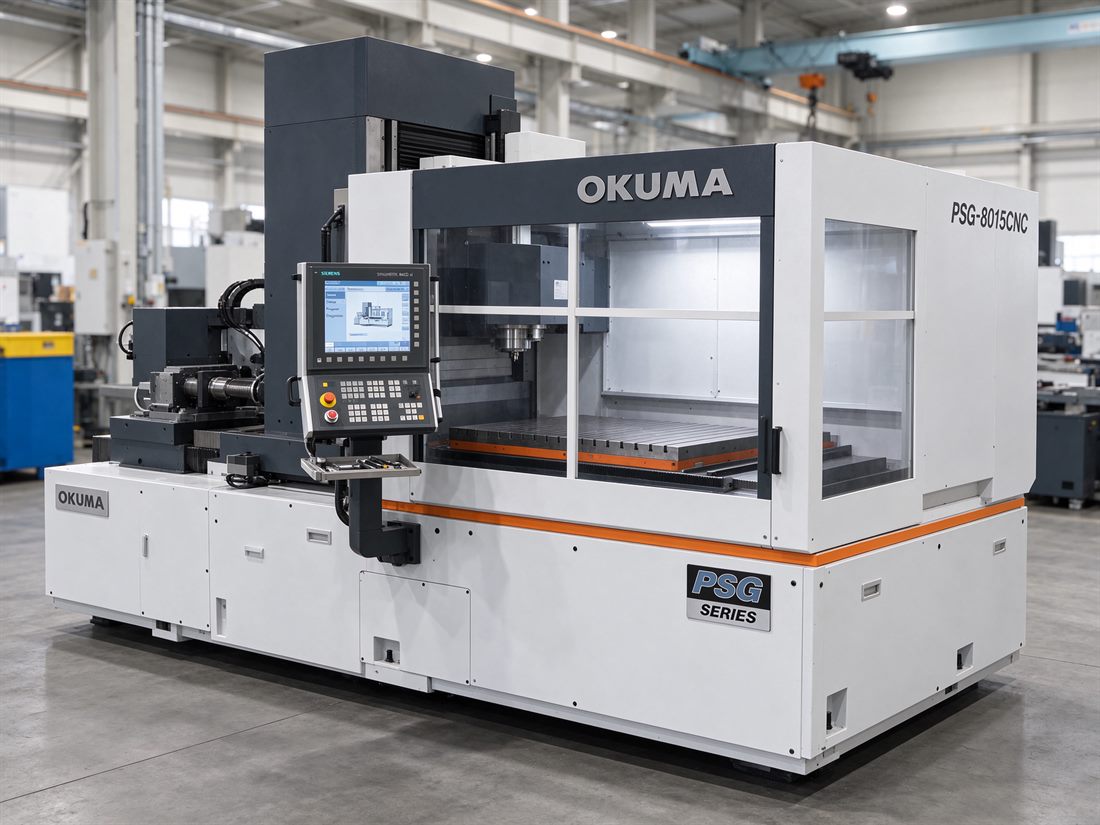
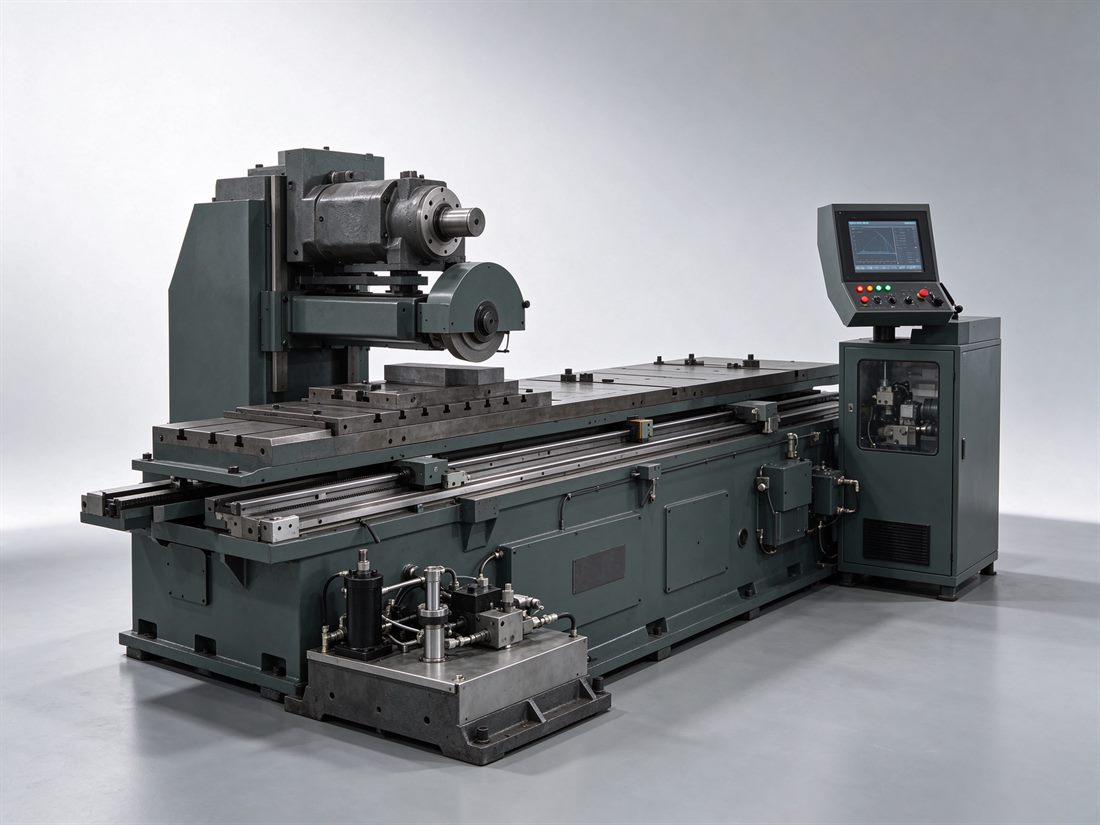
On a modern machine the compensation is automatic. A PSG-250SK3 CNC surface grinder maintains surface speed as it dresses, so the finish callout does not drift across a wheel's life — the same reason a CNC machine holds Ra 0.2 µm on the hundredth part where a manual machine with a shrinking wheel does not.
Whichever route you take, keep the wheel balanced as the diameter changes. A wheel that was balanced at 200 mm is not balanced at 160 mm, and the resulting vibration is what operators often attribute to "the speed being wrong". A wheel flange and balancing arbor set makes the re-balance a ten-minute job rather than a reason to live with the marks.
FAQ
What RPM should a surface grinder spindle run?
Whatever gives 30–33 m/s with your wheel: about 3,000 rpm for 200 mm, 4,000 rpm for 150 mm, 2,400 rpm for 250 mm.
Can I run a smaller wheel faster to keep the same surface speed?
Yes, if the spindle and the wheel rating allow it. Going from 200 mm to 150 mm needs 33% more RPM for the same m/s — check both limits before you do.
What happens if I run a wheel below its rated speed?
The wheel acts harder, glazes and burns the work, because the abrasive does not self-sharpen. Below 20 m/s on a vitrified wheel, expect burn within a few passes.
How do I know a wheel's maximum speed?
It is printed on the blotter and on the wheel itself, in RPM or m/s. Never exceed it, and ring-test the wheel before every mount.
Bottom line
Think in surface speed, set RPM from the diameter, and stay inside the blotter rating. If you tell us your spindle RPM, wheel diameter and material, we will tell you the surface speed you are actually running and whether a VFD or a different wheel size is the cheaper fix. Send your spindle and wheel details.