Surface Grinder Table Speed and Cross Feed Settings
Working numbers for surface grinder table speed and cross feed, by operation, with the spark density that tells you the setting is right.
- Table speed: what the number buys you
- Cross feed: the setting that leaves ridges
- Setting the three numbers together
- Reversal, dwell and the marks at the stroke ends
- Machine type and how the settings are made
- FAQ
- What is the correct table speed for surface grinding?
- How much cross feed per stroke?
- Why does my part burn at the ends of the stroke?
- Faster table speed means faster cycle, right?
- Bottom line
For precision surface grinding, run the table at 10–16 m/min with a cross feed of 0.3–0.6 of the wheel width per table stroke; for roughing, 18–24 m/min and 0.6–0.8 of the wheel width. Below 8 m/min the wheel rubs and burns; above 25 m/min the reversal shock marks the part and the wheel cannot clear the chip. Cross feed above one wheel width leaves ridges between passes that no spark-out will remove. Those three numbers — table speed, cross feed and depth of cut — are the whole of the process.
Table speed: what the number buys you
Table speed determines how long the wheel spends over each point on the part. Too fast and the wheel leaves before it has cut; too slow and it dwells, generating heat and burn.
| Operation | Table speed | Typical use | Effect of going faster |
|---|---|---|---|
| Roughing, mild steel | 18–24 m/min | Stock removal at 0.04–0.05 mm DOC | Higher removal, more wheel wear, Ra worsens |
| General precision | 12–16 m/min | Die plates, general toolroom | Ra rises about one grit step |
| Finishing | 8–12 m/min | Ra 0.4 µm callouts | Finish degrades quickly; burn risk rises |
| Fine finishing | 5–8 m/min | Ra 0.2 µm and below | Chatter from reversal shows in the finish |
| Spark-out | Same as finishing | Final 1–3 passes | Fewer effective passes; deflection remains |
On a hydraulic surface grinder, table speed is set by a flow control valve and read on a dial or, on better machines, on a graduated scale. The useful check is a stopwatch: time the table over a known stroke. A 500 mm stroke at 14 m/min should take about 2.1 seconds one way. If it takes 3.5 seconds, the valve or the pump is tired and your cycle time is 40% longer than the setting says.
Cross feed: the setting that leaves ridges
Cross feed is the sideways step between table strokes. If it is wider than the wheel's effective cutting width, every stroke leaves an uncut band, and the part comes out with a ridged surface that measures fine but looks wrong and fails a visual or sealing check.
The rule: cross feed should be 0.3–0.6 of the wheel width for precision work, up to 0.8 for roughing. On a 20 mm wide wheel that is 6–12 mm per stroke for precision, 16 mm for roughing. Because the wheel's edges do most of the cutting, the outer 1–2 mm of a dressed wheel is effectively a finishing edge — which is why keeping the step inside 0.6 of the width gives you overlap with that edge.
- Too wide: visible ridges, Ra doubles, and spark-out cannot recover it because the ridge is a depth error, not a roughness.
- Too narrow: cycle time climbs proportionally. A 0.2 wheel-width step on a 300 mm plate takes 2.5 times the strokes of a 0.5 step.
- Right: a faint uniform spark field across the full face, no bright bands at the stroke ends.
Setting the three numbers together
The three parameters are not independent. Raising table speed forces a lower depth of cut for the same burn limit; widening cross feed raises the effective removal rate but costs finish. This table is the combination that works on a 2.2–4 kW machine with a 60 grit wheel.
| Goal | Table speed | Cross feed (% of wheel width) | Depth of cut | Expected Ra |
|---|---|---|---|---|
| Maximum removal | 20–24 m/min | 70–80% | 0.04–0.05 mm | Ra 1.0–1.6 µm |
| Balanced production | 14–18 m/min | 50–60% | 0.03 mm | Ra 0.6–0.8 µm |
| Precision finishing | 10–12 m/min | 35–45% | 0.01 mm | Ra 0.3–0.4 µm |
| Fine finishing | 6–8 m/min | 30% | 0.005 mm | Ra 0.15–0.25 µm |
If a part burns at the "balanced production" setting, the fix is usually one step slower on the table, not a smaller depth of cut — burning is dwell time as much as chip thickness.
Reversal, dwell and the marks at the stroke ends
At each end of the table stroke the hydraulic system reverses. A clean reversal is instant; a worn valve pauses for 30–80 ms, during which the wheel dwells on the part and leaves a burn line or a deeper groove. On a part that must be flat to 0.005 mm, those end marks are the first thing a customer sees.
Two practical countermeasures: set the table stroke so the reversal happens 10–15 mm beyond the part edge (never inside the cut), and check the hydraulic oil temperature — a cold machine at 20 °C reverses harder than one at 40 °C, and the difference is visible in the finish on the first ten parts of a shift.
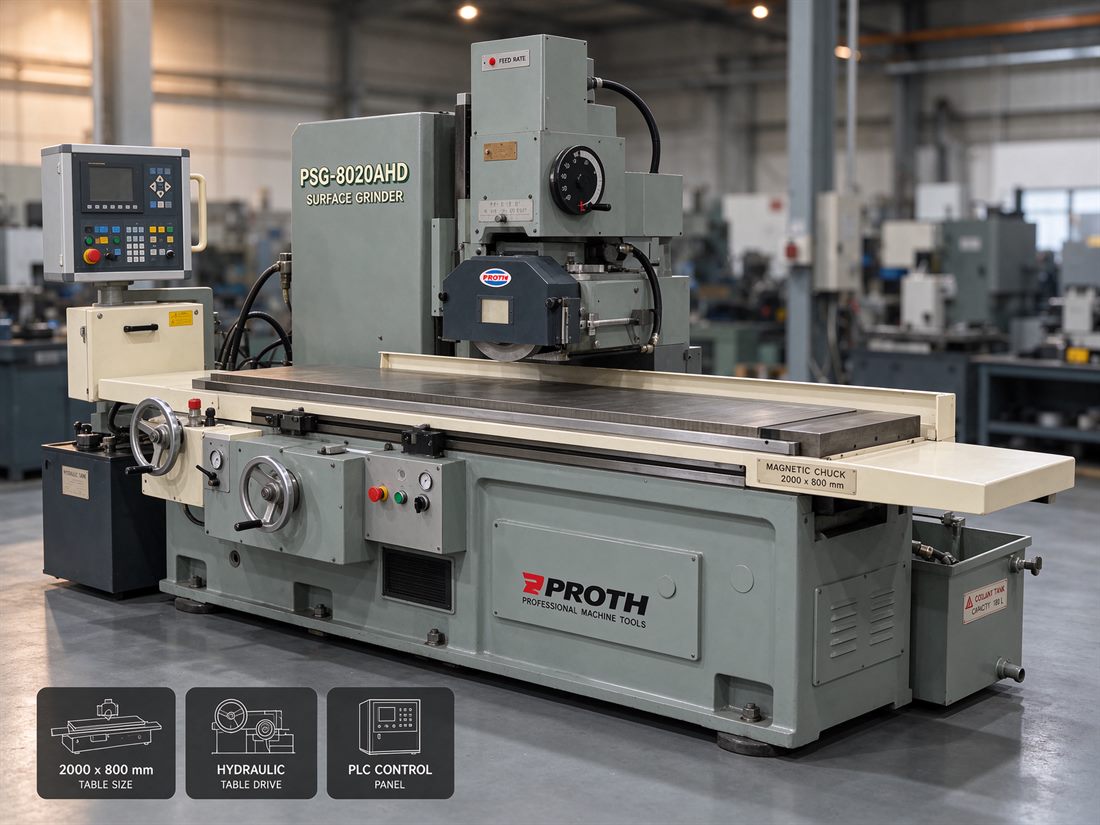
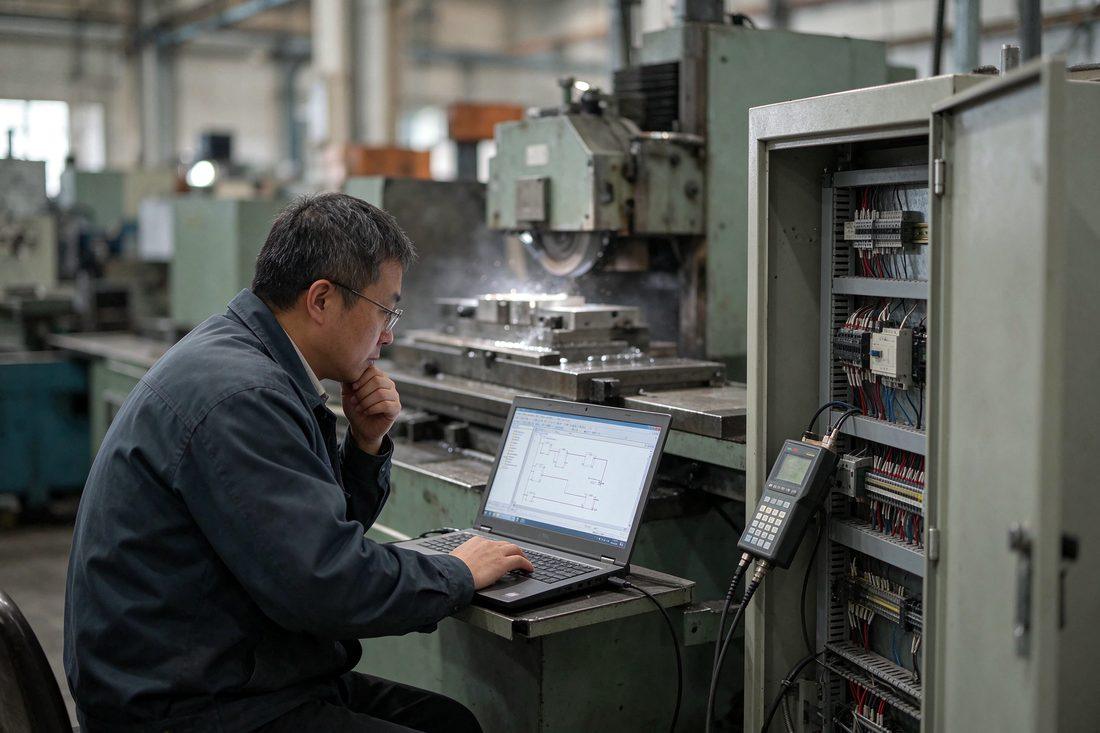
On a PLC machine the three numbers are set in the program, not by feel: table speed, cross feed step and downfeed per cycle become repeatable parameters.
Machine type and how the settings are made
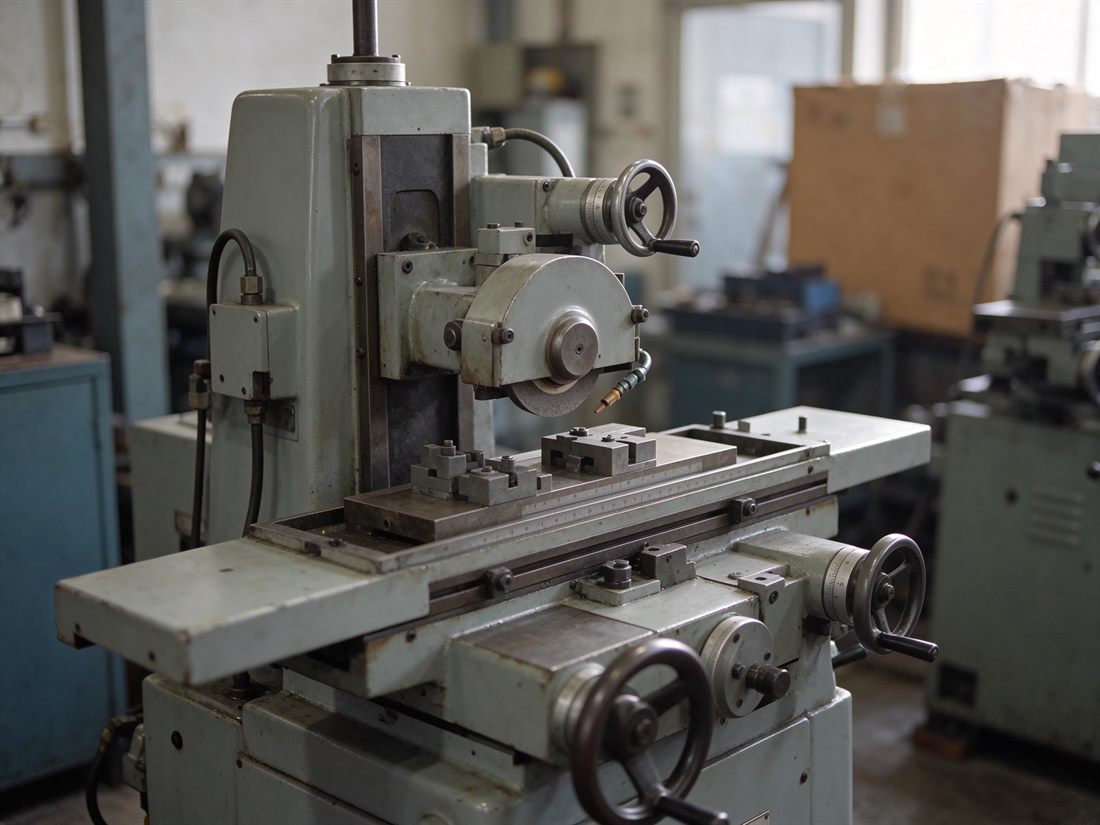
On a manual machine, the operator turns the cross feed handwheel one increment per stroke and judges the step by feel. It works, and it is the reason manual machines hold tolerance only as long as the operator stays attentive.
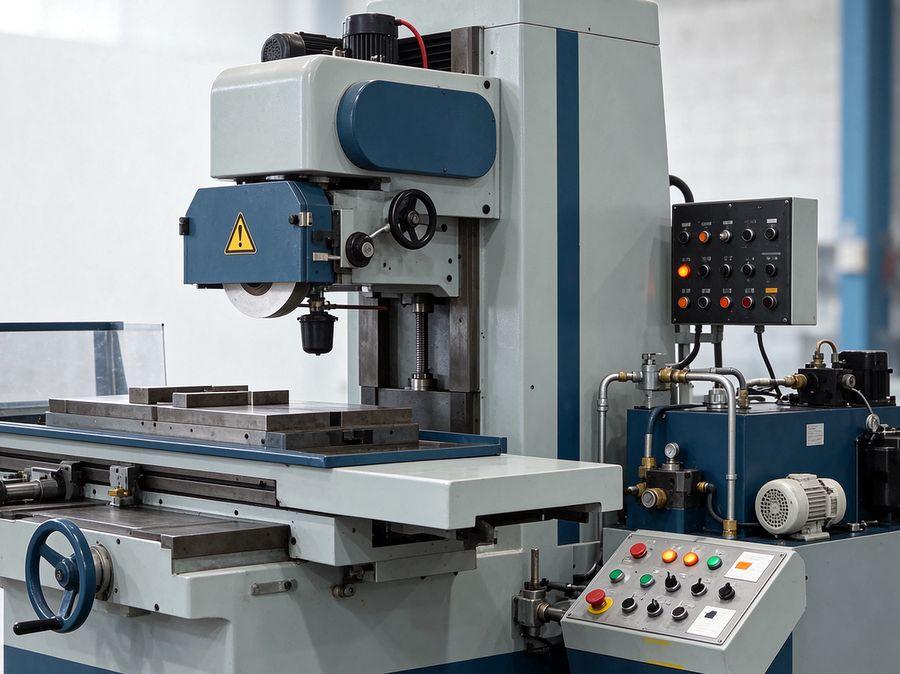
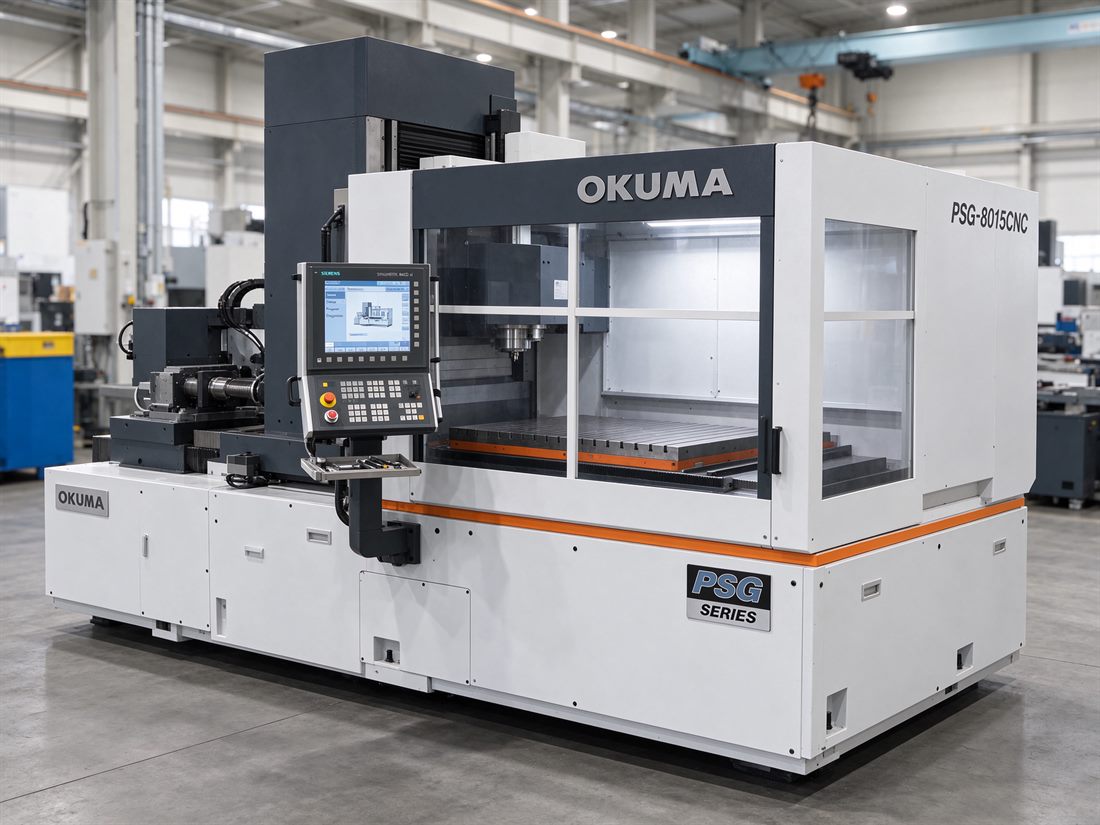
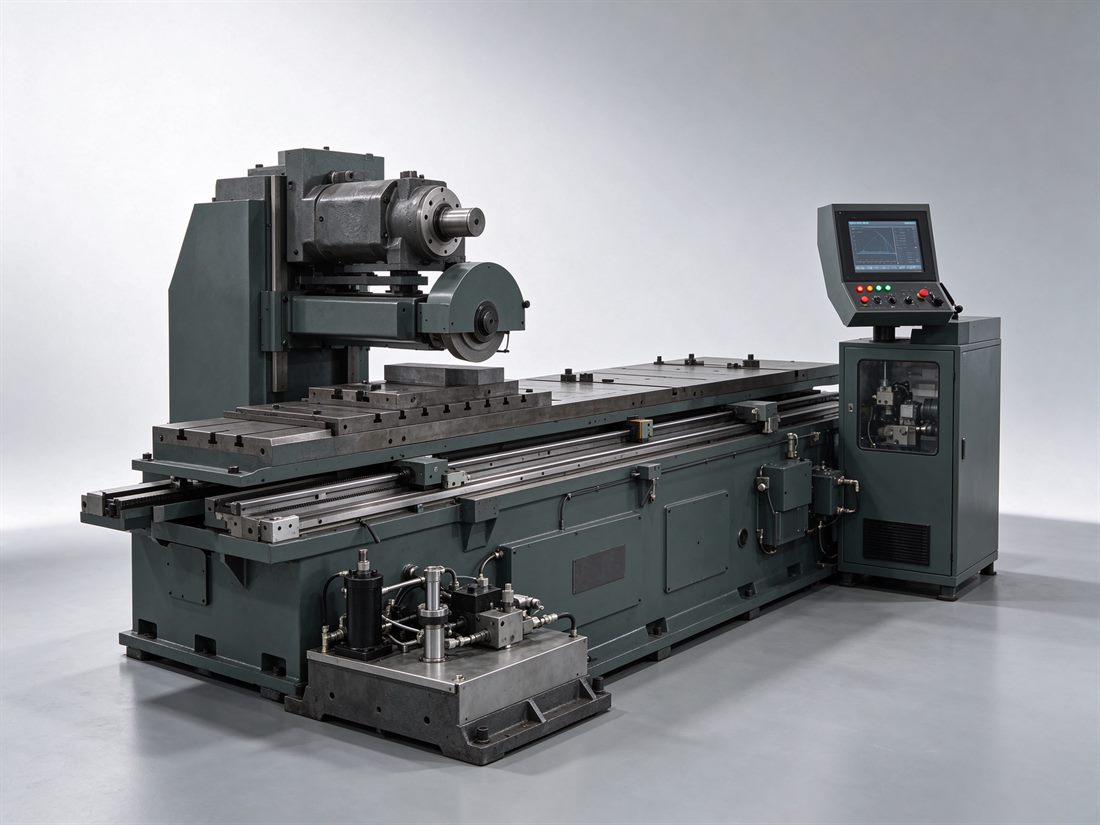
On a hydraulic automatic machine, both table speed and cross feed are set on valves or dials and then repeat for the whole batch. That is the real productivity difference: a PSG-250AH hydraulic surface grinder takes the same step every stroke for 400 parts, which is why thickness variation across a batch drops from 0.01 mm to 0.005 mm.
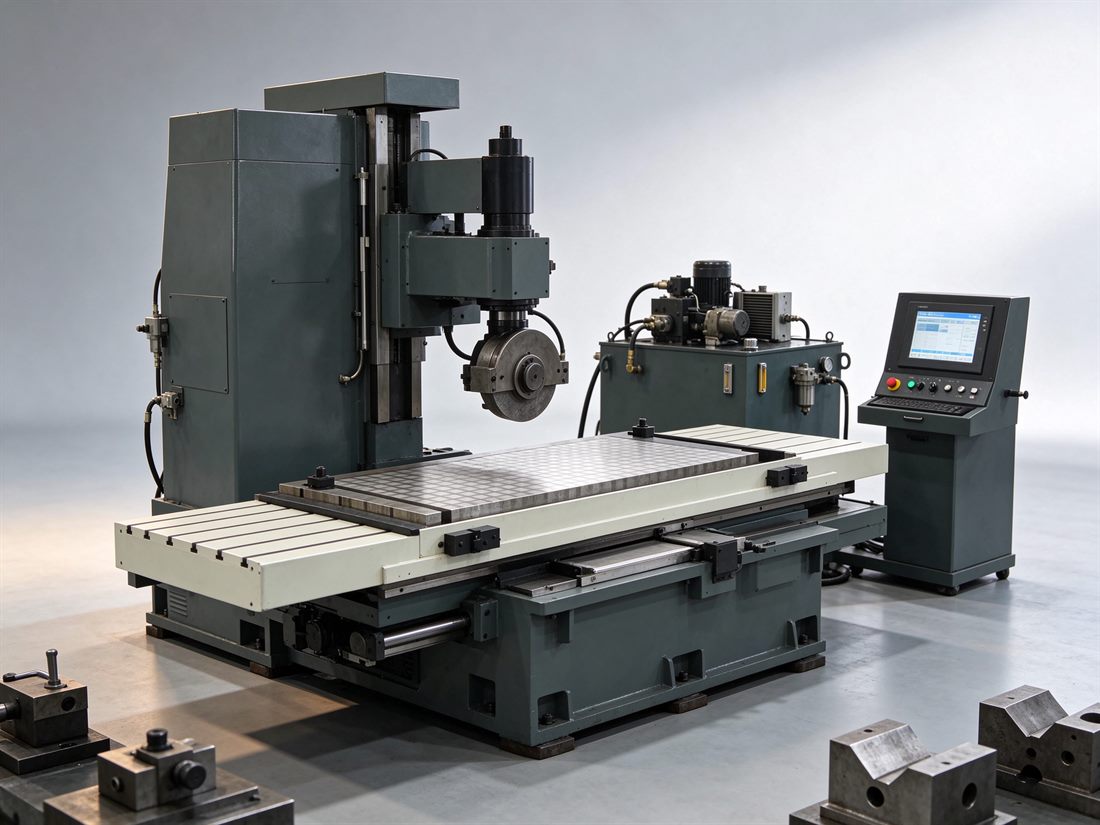
On PLC and CNC machines the values are numerical parameters, and the useful step beyond automation is programmable variation: a fast roughing phase followed by a slower finishing phase in one program. A PSG-8020WMS PLC surface grinder can be set to run 0.03 mm roughing passes at 20 m/min and finish with three 0.005 mm passes at 10 m/min without the operator touching a dial.
FAQ
What is the correct table speed for surface grinding?
12–16 m/min for precision work, 18–24 m/min for roughing, 6–10 m/min for fine finishing. Below 8 m/min the wheel dwells and burns.
How much cross feed per stroke?
0.3–0.6 of the wheel width under 20 mm for precision, up to 0.8 for roughing. Above one wheel width you get ridges.
Why does my part burn at the ends of the stroke?
The table reverses inside the part, so the wheel dwells. Move the stroke 10–15 mm past the part edge and check hydraulic oil temperature.
Faster table speed means faster cycle, right?
Only up to the burn limit. Past it you lose the part to rework, and cycle time rises. Find the fastest speed that leaves no temper colour, then back off 10%.
Bottom line
Set table speed by the finish callout, cross feed inside 0.6 of the wheel width, depth of cut by the material's hardness — then leave the machine to repeat it. If you tell us the part, the finish and the batch size, we will recommend a machine whose feeds are repeatable at your numbers, hydraulic or PLC. Request a process and machine recommendation.