Grinding Wheel Glazing and Loading: Fix It Fast
Why a grinding wheel stops cutting on a surface grinder: glazing versus loading, how to tell them apart, and the settings that stop both.
- Tell them apart in ten seconds
- Why glazing happens: a grade and speed problem
- Why loading happens: aluminium, soft steel and dirty coolant
- The dressing discipline that prevents both
- Cutting aluminium without loading the wheel
- Points to check before blaming the wheel
- FAQ
- How do I know if my wheel is glazed or loaded?
- Can I fix a glazed wheel without dressing it?
- Why does my wheel stop cutting halfway through a batch?
- Does coolant stop glazing?
- Bottom line
Glazing is the wheel's abrasive grains wearing flat and losing their cutting edges; loading is swarf filling the spaces between those grains. Glazing looks like a polished, shiny band on the wheel face and the part starts burning instead of cutting. Loading looks like a dark, smeared band and the part comes out with poor finish but no burn. Both feel the same to the operator — the wheel "stops cutting" — and both are fixed within one dressing, but the setting that prevents each is different.
Tell them apart in ten seconds
| Sign | Glazing | Loading |
|---|---|---|
| Wheel face appearance | Shiny, glassy, light band | Dark, smeared, metal-coloured band |
| Part appearance | Burn and temper colours, high Ra | Smears, poor Ra, no burn colour |
| Spark pattern | Sparse sparks, concentrated at one spot | Sparks still present but dull and short |
| Sound | Higher pitch, sometimes squeal | Lower, thudding, sometimes silent |
| Force needed | Downfeed feels jammed | Normal downfeed but no material removed |
| Immediate fix | Dress sharp, reduce DOC | Dress open, increase coolant, coarser grit or softer grade |
If you cannot see the wheel face clearly, the sound and the burn colour decide it: burn means glazing, no burn with poor finish means loading.
Why glazing happens: a grade and speed problem
Glazing comes from a wheel that is too hard for the work, or from a cut that generates more heat than the coolant can remove. The abrasive grains do not break down and expose fresh edges, so the flat grains rub instead of cut.
- Grade too hard. A K grade wheel on hardened steel at 0.02 mm will glaze; a J grade on the same job self-sharpens. This is the single most common cause.
- Depth of cut too light. Under 0.005 mm the wheel rubs rather than cuts, generating heat without forming a chip.
- Table speed too slow. Under 8 m/min, dwell time rises and the same rubbing heat appears.
- No coolant at the contact zone. A nozzle aimed at the wheel rim rather than into the nip floods the wrong place and still lets the wheel glaze.
The mechanical fix is one grade softer, or a coarser grit. The process fix is at least 0.01 mm depth of cut, 10–16 m/min table speed, and a nozzle aimed at the contact point rather than the wheel.
Why loading happens: aluminium, soft steel and dirty coolant
Loading is a chip-evacuation problem. The spaces between the abrasive grains fill with material and the wheel can no longer cut, even though the grains are still sharp underneath.
- Soft, gummy materials — aluminium, copper, low-carbon mild steel — weld to the grains. Grinding aluminium needs a coarse, open, soap-coolant process or a dedicated wheel.
- Coolant saturation. A flooded coolant tank with no filtration carries 1–3 kg of sludge per 1,000 L back to the wheel. That sludge plugs the porosity. Filtration is not optional above 120 grit.
- Wheel too fine and too dense. A hard, fine, low-porosity wheel loads on soft material. An open structure or a softer grade clears it.
- No filtration, no settling. A tank with a magnetic separator plus a paper filter removes 90%+ of the solids; a plain tank removes almost none.
Where the coolant goes decides whether the wheel glazes: the nozzle has to aim at the wheel-part contact, not at the wheel rim.
The dressing discipline that prevents both
Both glazing and loading are cured by dressing, so the real question is how often. The answer is a count, not a feeling.
| Operation | Dress every N parts | Dress depth | Diamond pass speed |
|---|---|---|---|
| Roughing, 46 grit, mild steel | 100–150 parts | 0.02–0.03 mm | 150–250 mm/min |
| General precision, 60 grit | 80–120 parts | 0.015–0.02 mm | 150–200 mm/min |
| Finishing, 120 grit | 40–60 parts | 0.01–0.015 mm | 100–150 mm/min |
| Hardened steel above 58 HRC | 40–80 parts | 0.015 mm | 120–180 mm/min |
| Aluminium (loading prone) | Every 20–30 parts | 0.02 mm | 200–300 mm/min |
Dress with a single-point diamond mounted at 5–15° to the wheel face, at a slow traverse, taking two passes: the first to remove the glazed layer, the second to true the face. Two passes at 0.015 mm cost under a minute and restore a wheel that was glazing.
If you find yourself dressing every ten minutes, the wheel is too hard and no dressing routine will fix it. Change grade.
Cutting aluminium without loading the wheel
Aluminium is the classic loading case, and it is solvable. Use a coarse wheel (36–46 grit), a soft grade (H–J), a high-porosity structure, and a water-soluble coolant at 8–12% concentration with a pressure flood. Take a deeper pass (0.05 mm) at a higher table speed so the chip is thick enough to be thrown clear instead of smeared into the porosity. If the aluminium is an alloy with high silicon, expect 10–20% more wheel wear and dress more often.
The economics are worth knowing: a $40 dedicated aluminium wheel that lasts 200 parts beats a $25 general wheel that loads every 20 parts and costs you the parts it ruined. The single point diamond dresser with holder keeps the wheel open between those dressings and is the least expensive way to keep an aluminium process running.
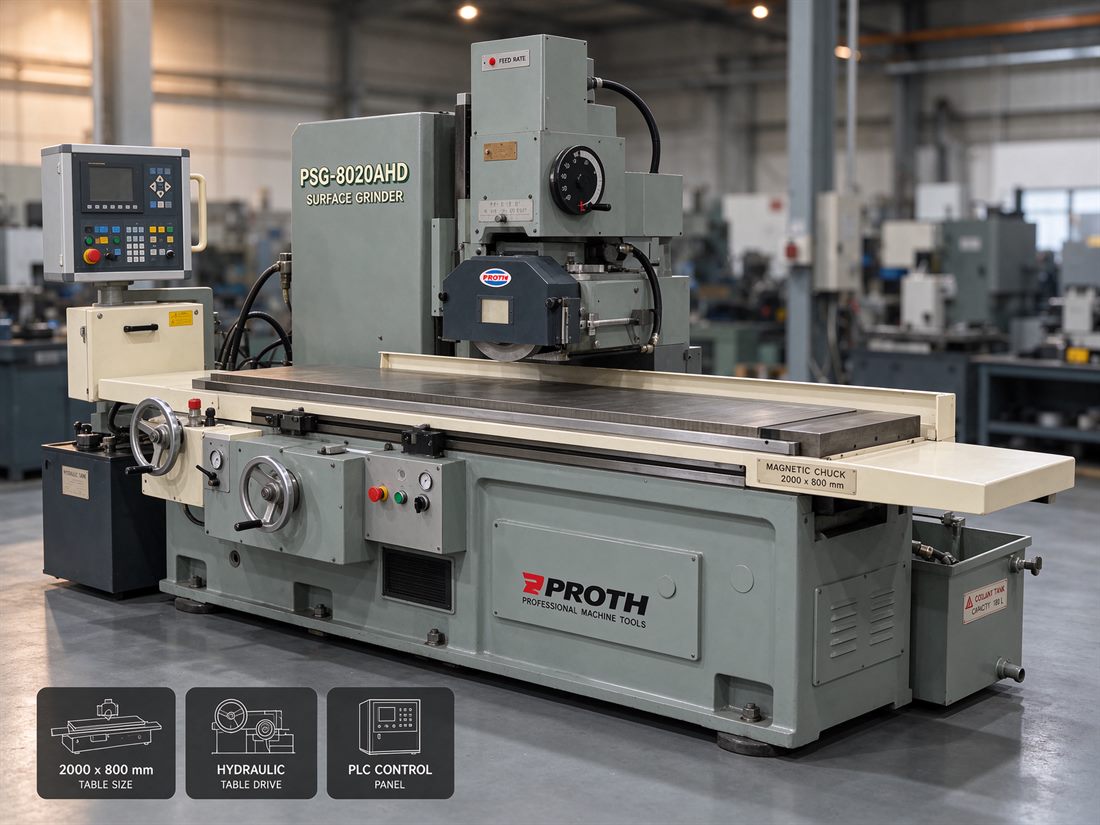
If loading keeps coming back on a machine that has otherwise been reliable, check coolant pressure and flow rate together. A 1.5 kW manual machine such as the PSG-618M runs a small tank and a low-head pump — enough for steel, marginal for aluminium. An aluminium process wants the flow that a PSG-250AH class machine provides, with the nozzle aimed into the contact zone rather than at the wheel.
Points to check before blaming the wheel
| Check | Why it matters | Quick test |
|---|---|---|
| Coolant concentration | Low concentration means poor lubricity and faster loading | Refractometer: 5–8% steel, 8–12% aluminium |
| Coolant flow at the nip | Flow at the wheel rim does not reach the cut | Aim nozzle, watch the wet band on the part |
| Sludge in the tank | Solids plug the wheel porosity | Dip the tank bottom: sediment over 5 mm is too much |
| Wheel balance | Imbalance looks like loading because sparks go uneven | Balance on a mandrel; a balancing stand takes ten minutes |
| Wheel hardness letter | Wrong grade is the root cause of glazing | Check the marking: J for hard work, K–L for general |
FAQ
How do I know if my wheel is glazed or loaded?
Look at the face and the part. Shiny wheel with burn colours on the part means glazing. Dark smeared wheel with poor finish but no burn means loading.
Can I fix a glazed wheel without dressing it?
No — a glazed wheel must be dressed. You can slow the glazing by softening the grade, raising the depth of cut above 0.01 mm, and speeding the table to 10–16 m/min.
Why does my wheel stop cutting halfway through a batch?
Either glaze from a hard grade at a light cut, or loading from unfiltered coolant. Check the wheel face, then the coolant tank sediment.
Does coolant stop glazing?
Coolant stops burn but does not stop glazing caused by a hard grade. It does prevent loading, provided it is filtered and at the right concentration.
Bottom line
A wheel that stops cutting is telling you one of two things: too hard a grade, or coolant that is no longer clean. Fix the grade, fix the filtration, and dress on a count. Send us the material, the wheel marking and a photo of the wheel face, and we will identify which of the two you have and what to change. Send the wheel marking and material for a review.