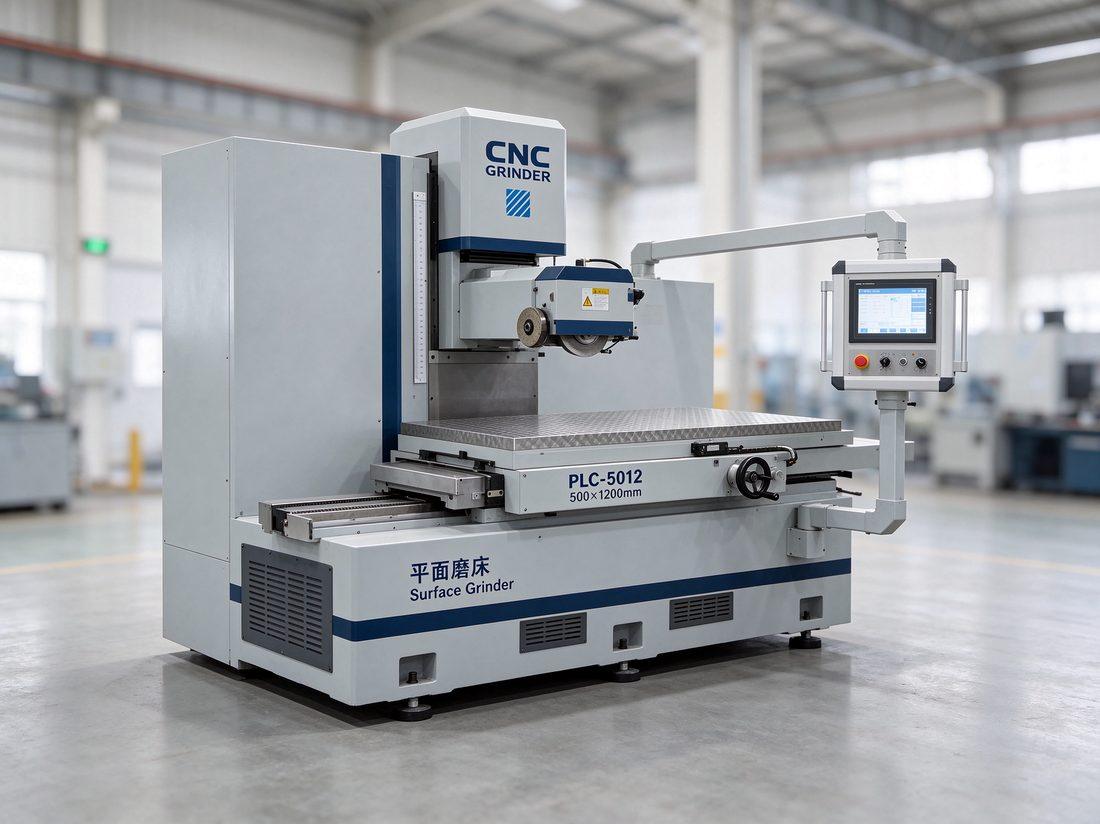
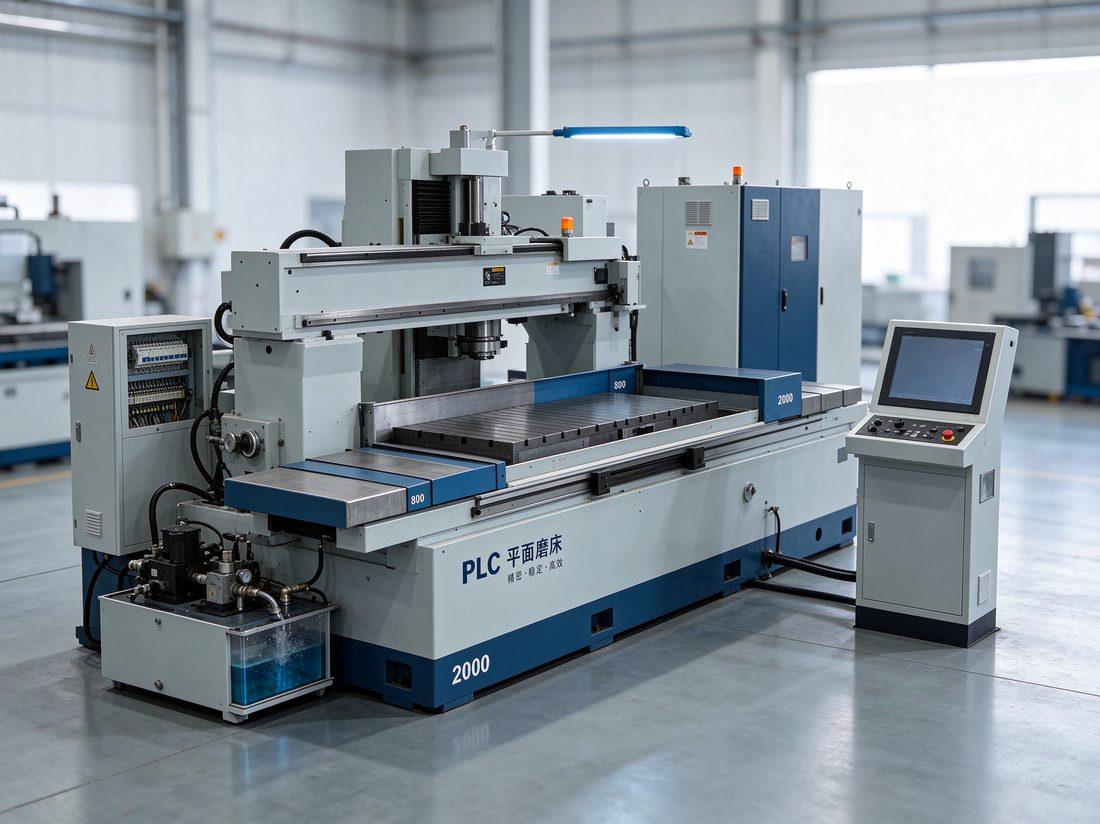
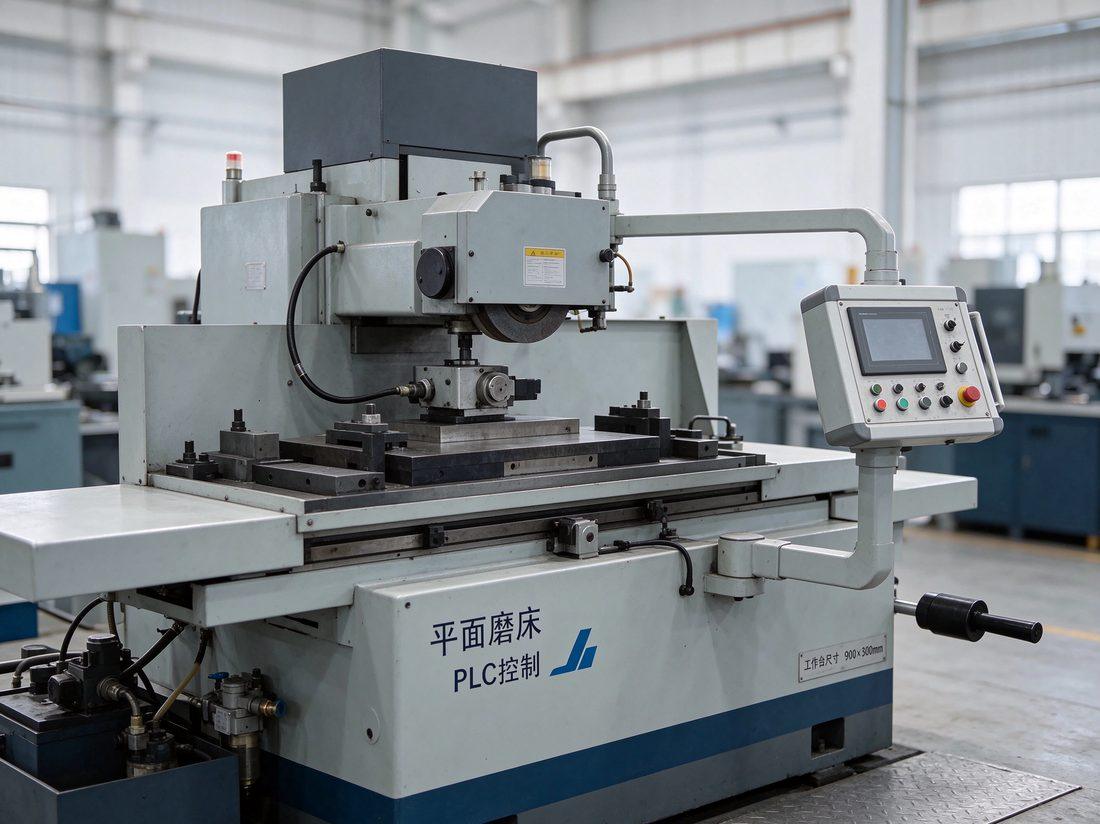
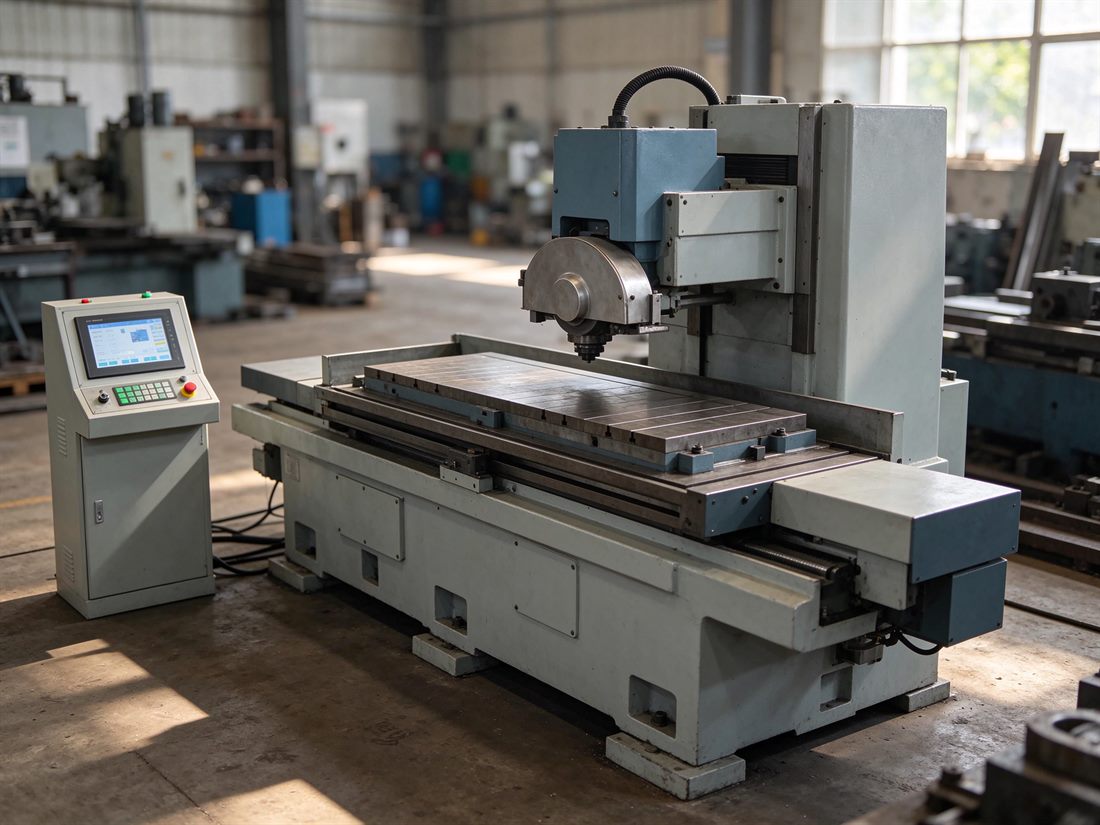
Three-axis PLC surface grinders with automatic down-feed, wheel dressing and grinding cycles.
A PLC surface grinder is the pragmatic middle: a programmable controller runs the grinding cycle — step depths, cross-feed indexing, spark-out count, coolant sequencing — while the table keeps its hydraulic or servo drive. There is no interpolation and no contouring, which means no CAM, no G-code training and no programmer, but the cycle repeats to the second, part after part.
Three models cover 500 × 125 mm to 900 × 300 mm at US$ 12,500–22,500: the PSG-5012WMS, the PSG-8020WMS and the PSG-9030WMS. All hold 0.002 mm positioning with 0.003 mm repeat accuracy.
Three-axis programmable surface grinders with automatic wheel dressing and cycle control. The pragmatic step between a hydraulic grinder and a full CNC machine.
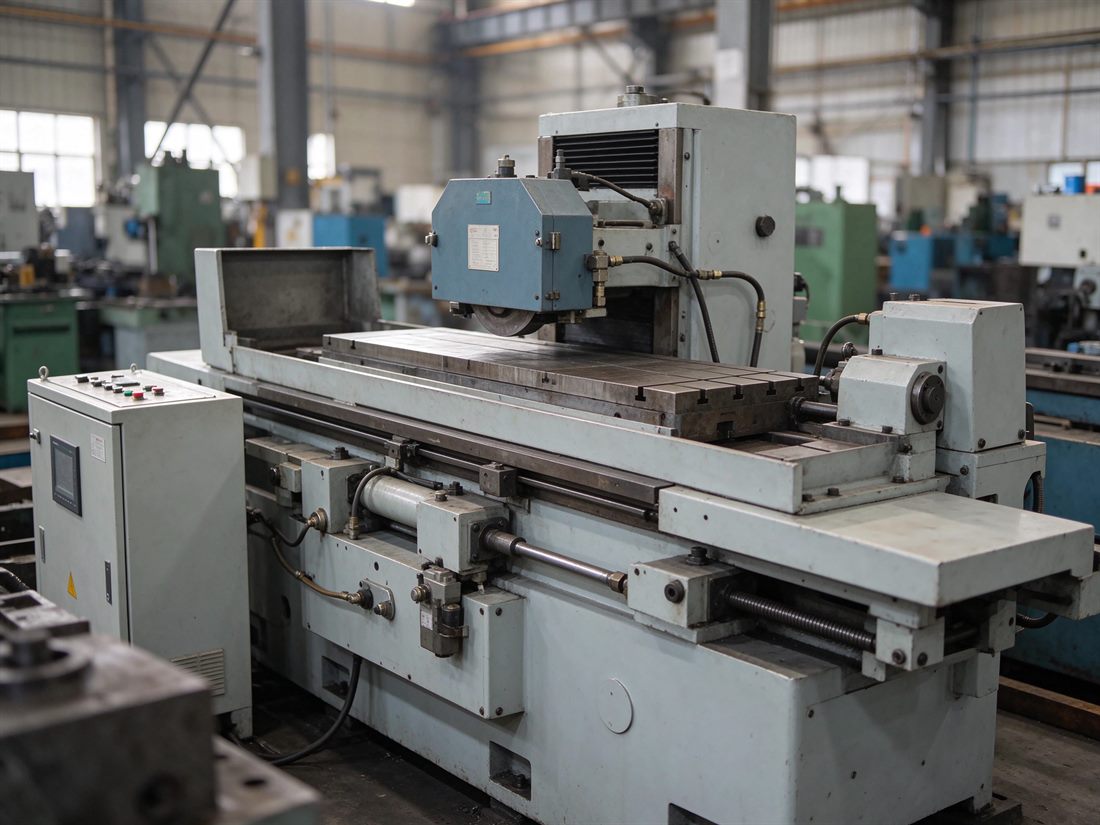
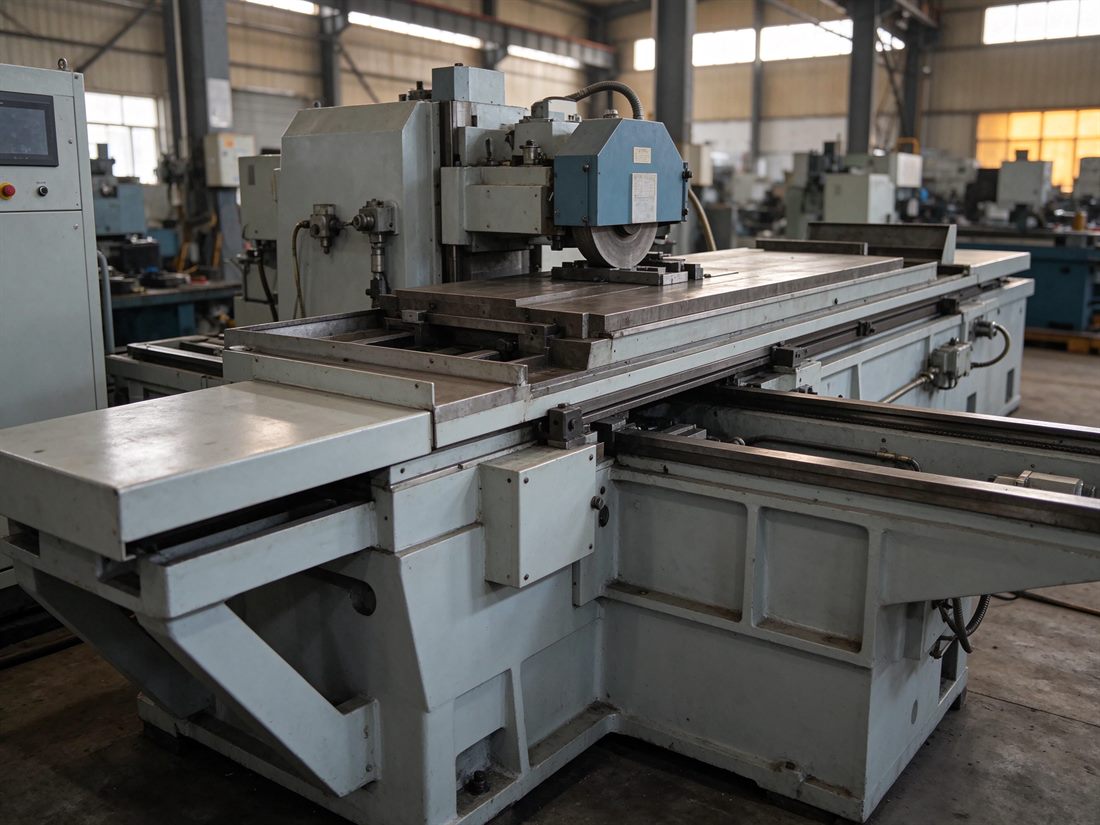
Both machines have programmed cycles. The difference is what the control can do with the axes:
| Task | PLC line (WMS) | CNC line (SK3 / 525CNC) |
|---|---|---|
| Step grinding to set depths | Yes | Yes |
| Incremental cross feed per stroke | Yes | Yes |
| Programmed spark-out passes | Yes | Yes |
| Wheel wear compensation with programmed dressing | Partial | Yes |
| Dressing a form into the wheel (angles, radii) | No | Yes |
| Teaching / programming effort | Hours | Days |
| Indicative FOB, 500 mm class | US$ 12,500 | US$ 28,000 |
If your parts are flat, parallel and stepped — which covers most die plates, bolster plates, guide rails and fixture bases — the PLC line does the whole job for less than half the price of a CNC machine. If the wheel needs a form dressed into it, you need CNC.
PSG-5012WMS (500 × 125 mm, US$ 12,500) — narrow, fast, built for slats, blades, punches and long thin parts where the 125 mm chuck is enough. Its small table gives high traverse rates without a big power pack.
PSG-8020WMS (800 × 200 mm, US$ 16,800) — the volume machine. 800 mm of length with 200 mm of width takes most die plates in one set-up, at a footprint that still fits a normal bay.
PSG-9030WMS (900 × 300 mm, US$ 22,500) — the wide one, for bolster plates and large inserts that need both length and width. This is the model that replaces a 5010AH hydraulic machine when the buyer wants repeatability instead of throughput.
A typical program, entered at the panel in ten minutes:
Then it repeats until the counter stop is reached. Wheel wear is handled by re-setting the tool offset after each manual dress — a four-button procedure documented on a card that ships with the machine.
Tell us the destination country (the control panel language and voltage differ), the chuck size, whether you grind dry or wet, and whether you need a demagnetiser cycle. The PLC is supplied with an English interface as standard; a bilingual panel is available at no extra cost where it helps the operator. Delivery is 25–45 days, FOB Ningbo or Shanghai.
Compare with the automatic hydraulic line if throughput matters more than repeatability, or the CNC line if the wheel needs forming. Chucks, dressers and coolant hardware for all three WMS models are in parts and accessories.
| Specification | PSG-5012WMS PLC Programmable Surface Grinder (500 × 125 mm) | PSG-8020WMS PLC Programmable Surface Grinder (800 × 200 mm) | PSG-9030WMS PLC Programmable Surface Grinder (900 × 300 mm) | PSG-3010WMS PLC Surface Grinder (1000 × 300 mm) | PSG-4015WMS PLC Surface Grinder (1500 × 400 mm) | PSG-6020WMS PLC Surface Grinder (2000 × 600 mm) |
|---|---|---|---|---|---|---|
| Table size | 500 × 125 mm | 800 × 200 mm | 900 × 300 mm | 1000 × 300 mm | 1500 × 400 mm | 2000 × 600 mm |
| Max grinding length | 520 mm | 820 mm | 950 mm | 1,060 mm | 1,560 mm | 2,060 mm |
| Max grinding width | 125 mm | 200 mm | 300 mm | 320 mm | 420 mm | 620 mm |
| Grinding wheel | 200 × 20 × 50.8 mm | 250 × 25 × 76.2 mm | 350 × 40 × 127 mm | 350 × 40 × 127 mm | 350 × 50 × 127 mm | 400 × 50 × 203 mm |
| Spindle motor | 1.5 kW | 3 kW | 5.5 kW | 5.5 kW | 7.5 kW | 11 kW |
| Control | 3-axis PLC, 20 programs | 3-axis PLC, 20 programs | 3-axis PLC, 20 programs | PLC, 7-inch touch HMI, 20-program memory | PLC, 7-inch touch HMI, 50-program memory | PLC, 10-inch touch HMI, 100-program memory |
| Positioning accuracy | 0.005 mm | 0.005 mm | 0.005 mm | 0.002 mm | 0.002 mm | 0.002 mm |
| Machine weight | 1,100 kg | 2,600 kg | 4,100 kg | 2,600 kg | 4,200 kg | 7,800 kg |
| Spindle speed | — | 1,450 rpm | — | 1,450 rpm | 1,450 rpm | 1,450 rpm |
Figures are the catalogue specification for each model. Where a machine is built to order — larger tables, special voltages, extra coolant capacity — the final values are confirmed on the order drawing.
No. It has a programmable cycle — steps, cross feed, spark-out — but no interpolation between axes, so it cannot dress a form into the wheel or grind a contour. It is a hydraulic-class machine with a repeatable, recordable cycle.
Yes. Setup is a sequence of numeric fields, not G-code: pass depth, number of passes, cross-feed per stroke, spark-out count. We ship a laminated one-page procedure and a set of six worked examples; most operators are running production the same day.
Repeatability and documentation. The 250AH needs the down feed watched and a hand on the spark-out; the 5012WMS repeats the whole cycle including spark-out, and the depths are recorded rather than set by eye. That is what makes it worth roughly US$ 2,700 more.
PSG-8020WMS. It takes the plate in one set-up at 16,800 US$. A 9030WMS is needed only when the plate is wider than 200 mm; a 6015AHD hydraulic machine is the alternative when the plate is long and heavy.
Yes. The controller is an industrial PLC with standard I/O, the drives are conventional, and we supply the wiring diagram, the parameter backup and the spare-parts list. Spares are held for 15 years and air-freighted within 72 hours.
Laser check on the positioning axes plus a test-ground hardened block. You get the positioning record, the flatness and roughness figures of the test part, and the cycle parameters that produced them.

