How Much Spindle Power Does Your Grinding Actually Need?
Depth of cut, wheel width and contact area decide the power you need — not the size of the part.
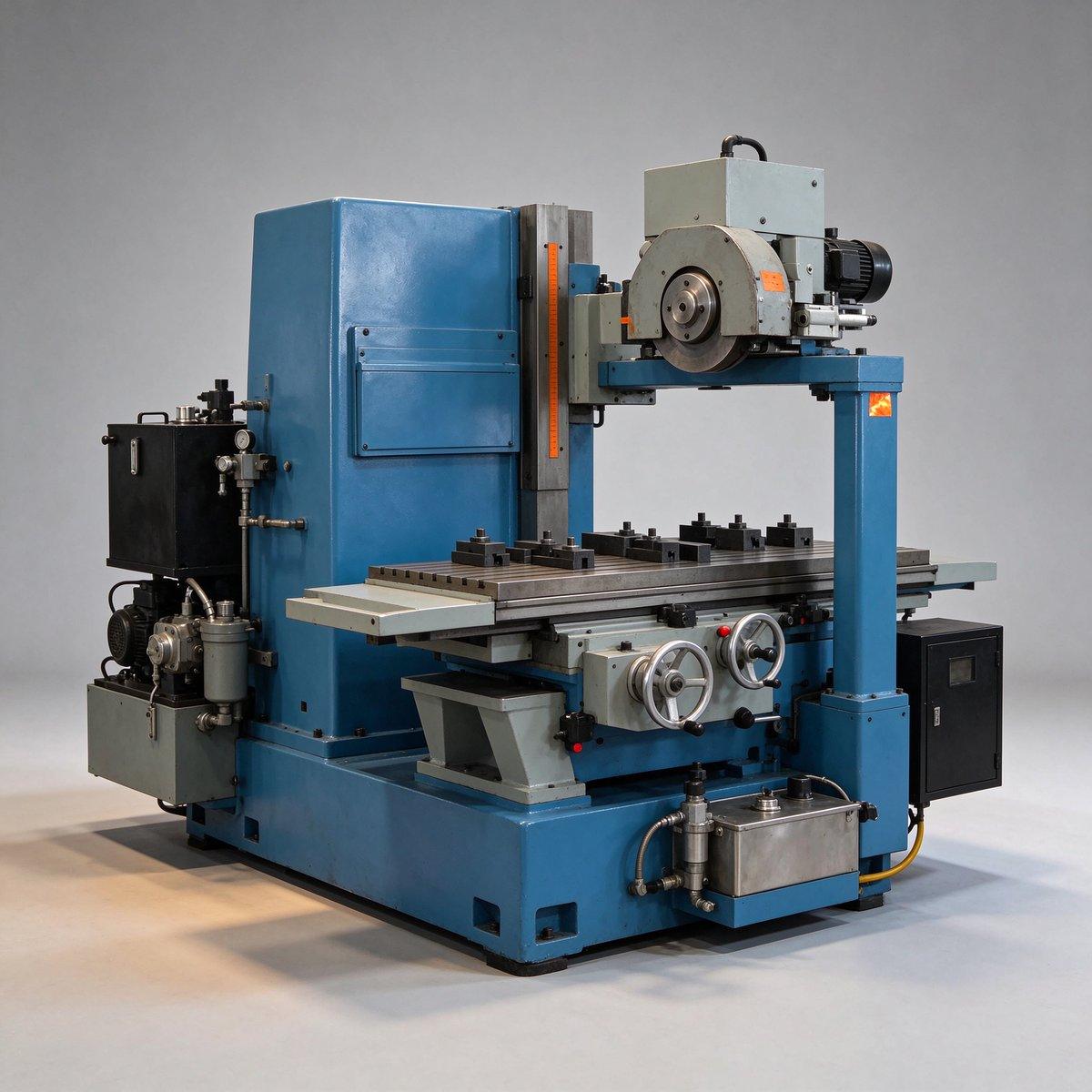
The mistake
Buyers often size spindle power to the part size: a big plate must need a big spindle. It does not work that way. Power is consumed per unit of contact area and per unit of material removed, so a 2 m thin plate in a finishing pass needs less power than a 400 mm hardened block in a roughing pass.
What the spindle is actually doing
Specific grinding energy for hardened tool steel runs at roughly 10–20 J/mm³ at normal depths, and higher when the wheel is dull or the depth is very small. Multiplying that by the removal rate gives the power required at the wheel.
Worked figure: a 350 mm wheel, 40 mm wide, taking 0.2 mm off a 100 mm wide plate at 10 m/min table speed. Removal rate is 40 × 100 × 0.2 per pass, and with roughly 60 passes per minute of table travel the metal removal rate is about 4,800 mm³/min. At 15 J/mm³ that is about 1.2 kW at the wheel — well within a 5.5 kW spindle once efficiency is accounted for.
So when do you need 11 kW?
| Job | Depth per pass | Realistic spindle |
|---|---|---|
| Finishing, 0.01–0.03 mm | 0.02 mm | 3–5.5 kW |
| General plate work | 0.15–0.25 mm | 5.5–7.5 kW |
| Roughing hardened plate, 400 mm wheel | 0.4–0.5 mm | 11 kW |
| Vertical-spindle face grinding | 0.3–0.5 mm full width | 11–15 kW |
The table is honest about one thing: the jump from 5.5 to 11 kW exists to take deeper passes on wider wheels, not to finish better. Finishing quality comes from wheel grade, dressing and spark-out.
The cost of too much power
An oversized spindle adds mass to the wheelhead, more heat to the column, and a bigger hydraulic or servo package to hold position. A 15 kW wheelhead on a 600 mm table machine will move the column 0.03 mm between a cold start and mid-afternoon unless you warm it up. Too much power is not free; it is paid for in thermal drift and in warm-up time.
A practical way to decide
Write down the deepest cut you intend to take on the hardest material you grind, and the wheel width you will use. If the answer is under 0.2 mm on a 40 mm wheel, a 5.5–7.5 kW machine covers it with margin. If it is 0.4 mm on a 63 mm wheel, you need 11 kW and a machine with the mass to match. Then check the chuck and the coolant, because those two limit the process long before the spindle does.
Send us the material, the depth and the wheel you intend to run, and we will confirm the spindle size rather than up-sell it — application engineers.