What a Surface Grinder Costs per Hour to Run
The real hourly cost of running a surface grinder: machine depreciation, labour, power, wheels, coolant and floor, with a worked shop rate.
- The cost stack, line by line
- Why labour dominates
- A worked shop rate
- What actually moves the number
- Buying decision: does the more expensive machine pay?
- FAQ
- What should I charge per hour for surface grinding?
- How much does a surface grinder cost to run per hour excluding labour?
- Is a hydraulic surface grinder worth more than a manual one?
- How do I price a single grinding job?
- Bottom line
A surface grinder costs roughly USD 12–25 per hour to own and run before labour, and USD 35–60 per hour all-in once an operator is charged at a real shop rate. The machine itself is the smallest part of the number: on a 900 kg hydraulic machine bought at USD 18,000 and run 1,500 hours a year for ten years, depreciation is about USD 1.50 per hour. Labour is typically 60–70% of the hourly cost, which is why a grinding quote lives or dies on cycle time, not on machine price.
The cost stack, line by line
Every hour a surface grinder runs carries seven cost lines. Most shops track two of them — labour and wheels — and then wonder why the work is not profitable.
| Cost line | Manual 6×18 | Hydraulic 500×250 | CNC 500×250 | Basis |
|---|---|---|---|---|
| Depreciation | USD 0.8/h | USD 1.5/h | USD 3.2/h | USD 8k / 18k / 38k over 10 y at 1,500 h/y |
| Floor and building | USD 0.6/h | USD 1.0/h | USD 1.2/h | USD 40/m²/month for 2–4 m² |
| Power | USD 0.5/h | USD 1.0/h | USD 1.4/h | 1.5–7.5 kW at 70% load, USD 0.12/kWh |
| Wheels and diamonds | USD 1.2/h | USD 2.0/h | USD 3.0/h | Wheel per 80–150 h, diamond per 200 h |
| Coolant and filtration | USD 0.4/h | USD 0.8/h | USD 1.0/h | Charge every 6–12 months plus filters |
| Maintenance and consumables | USD 0.8/h | USD 1.5/h | USD 2.5/h | 3–5% of machine value per year |
| Insurance and admin | USD 0.3/h | USD 0.5/h | USD 0.6/h | ~1% of asset value per year |
| Subtotal, machine only | USD 4.6/h | USD 8.3/h | USD 12.9/h |
Add a 40% allowance for idle time, setup and rework and the machine-only number lands at USD 6–8 per hour for a manual machine and USD 12–18 for a hydraulic one — which is where the "USD 12–25 before labour" figure comes from. The gap between a USD 8,000 machine and a USD 38,000 machine is only about USD 2.4 per hour in depreciation; the rest of the difference is floor, power and maintenance, all of which scale with the machine's size.
Why labour dominates
An operator at USD 20 per hour fully burdened — wage, tax, holiday, training, supervision — costs USD 28–32 per hour of attendance. That is three to seven times the machine-only cost. The consequence for pricing is direct: the way to make grinding profitable is to reduce the hours the operator spends per part, not to buy a cheaper machine.
Two numbers to know for any job:
- Setup hours per lot. Chuck clean, clamp, touch off, first-part check: 20–40 minutes on a manual machine, 15–25 minutes on a hydraulic one with a DRO.
- Cycle minutes per part. A 200 × 150 mm plate removing 0.15 mm at 0.04 mm per pass is 4 roughing passes plus 2 finishing passes; at 0.9 m/min table speed and 60% cross feed that is 3–5 minutes of grinding - and 2 minutes of measuring.
A lot of 10 parts with 30 minutes of setup and 5 minutes of cycle each is 80 minutes, or 8 minutes per part. A lot of 100 parts is 530 minutes, or 5.3 minutes per part. Setup amortisation is where small lots lose money, and it is the strongest argument for a DRO or a PLC control that shortens setup.
A worked shop rate
Take a hydraulic machine in a small shop, one operator, 1,500 productive hours a year:
| Item | Annual | Per productive hour |
|---|---|---|
| Machine depreciation | USD 1,800 | USD 1.20 |
| Floor, power, utilities | USD 2,400 | USD 1.60 |
| Wheels, diamonds, coolant, filters | USD 3,300 | USD 2.20 |
| Maintenance | USD 900 | USD 0.60 |
| Operator, fully burdened | USD 45,000 | USD 30.00 |
| Overhead: admin, sales, QA | USD 12,000 | USD 8.00 |
| Cost | USD 65,400 | USD 43.60 |
| Margin at 30% | USD 18.70 | |
| Shop rate | USD 62/hour |
That is the number to quote against. A shop quoting USD 40 per hour on this cost base is losing USD 22 every hour it works, and it will only notice when the machine needs replacing and there is no cash.
What actually moves the number
Four levers, in order of effect:
- Utilisation. The same fixed costs spread over 2,000 hours instead of 1,500 drop the machine portion by a quarter. Idle machines are the most expensive machines.
- Setup time. A DRO retrofit costing USD 400 that saves 10 minutes per lot pays back in under 30 lots.
- Wheel cost per part. A wheel that lasts 150 hours instead of 80 halves the wheel line — which is worth more than shopping around for a cheaper wheel.
- Rework. One scrapped die block costs more than a month of wheel consumption. Rework is a cost line in its own right and it rarely appears in a quote sheet.
Depreciation is only 5–10% of the hourly cost of grinding; labour and setup time decide whether a job is profitable.
Buying decision: does the more expensive machine pay?
Compare a manual machine at USD 8,000 against a hydraulic at USD 18,000. Depreciation difference is USD 1 per hour. The hydraulic machine's real advantage is cycle time and setup time: it removes the operator from the table and cross-feed loop, so a lot that took 8 minutes per part on a manual machine takes 5 on a hydraulic one. At USD 43.60 cost per hour, 3 minutes saved per part is USD 2.18 — on 20,000 parts a year that is USD 43,600, twenty times the price difference.
Below about 500 parts per year of grinding work, the hydraulic machine does not pay. Above 5,000, not buying it is the expensive choice. Between those, it depends on setup: if every lot is different, setup time dominates and a DRO on a manual machine is the better buy.
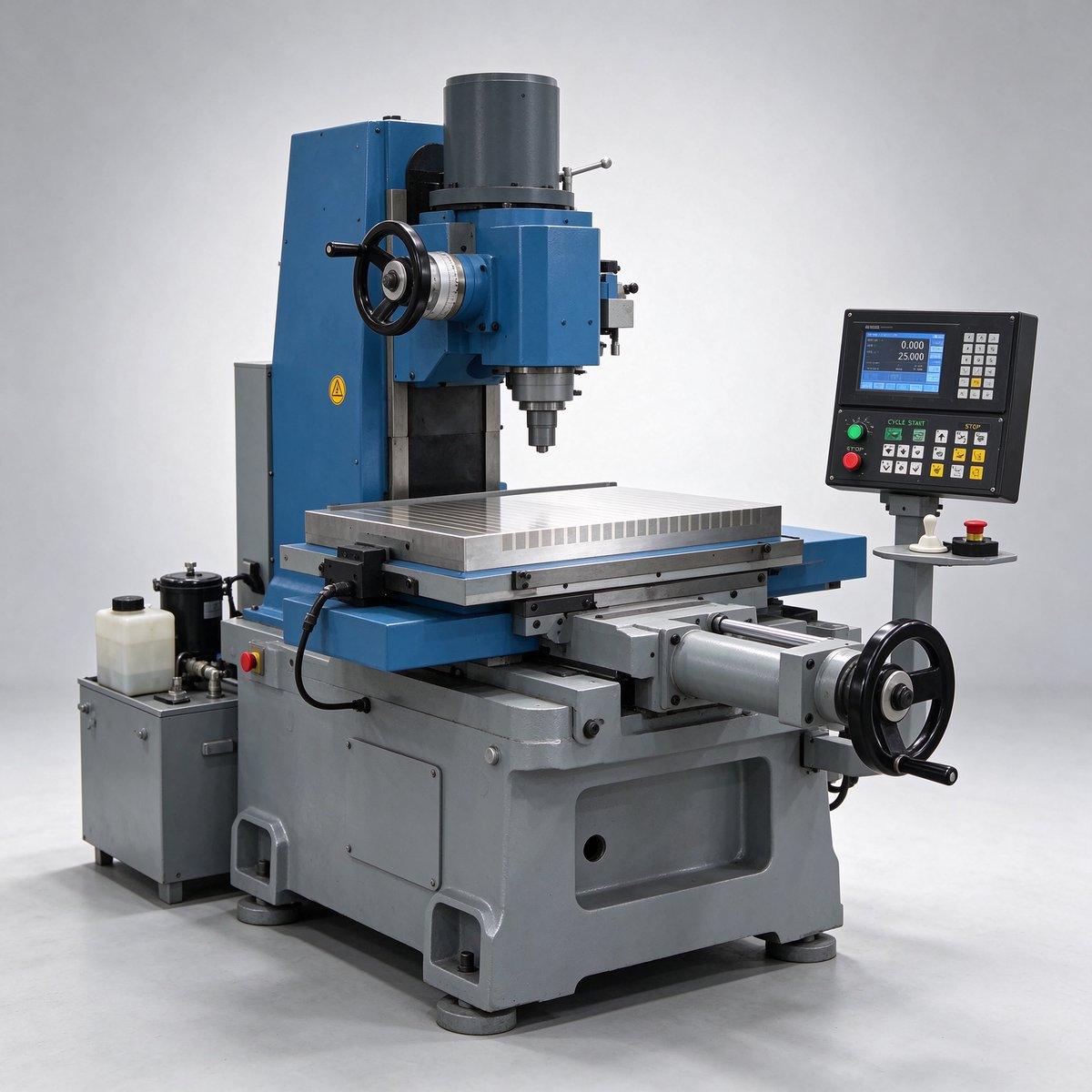
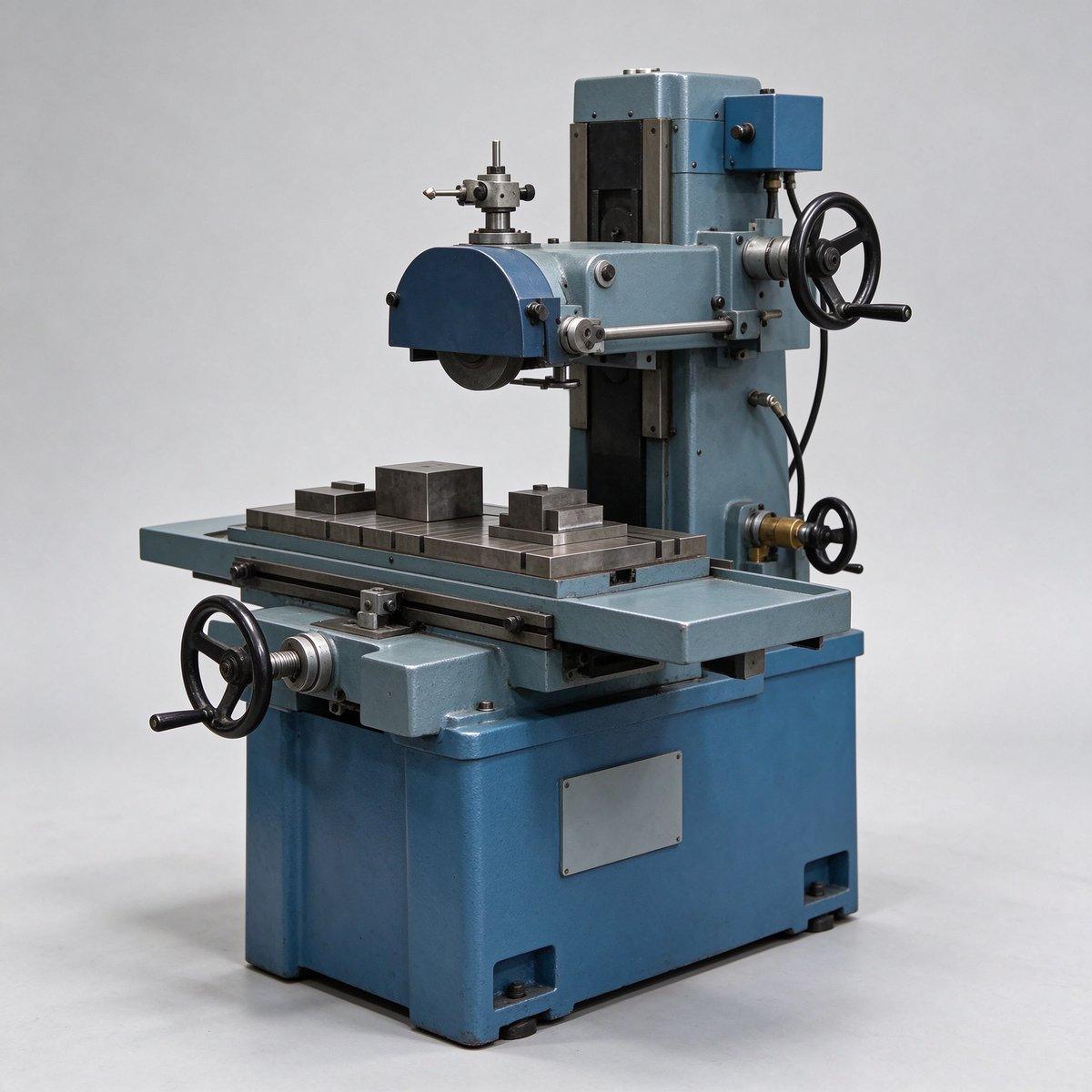
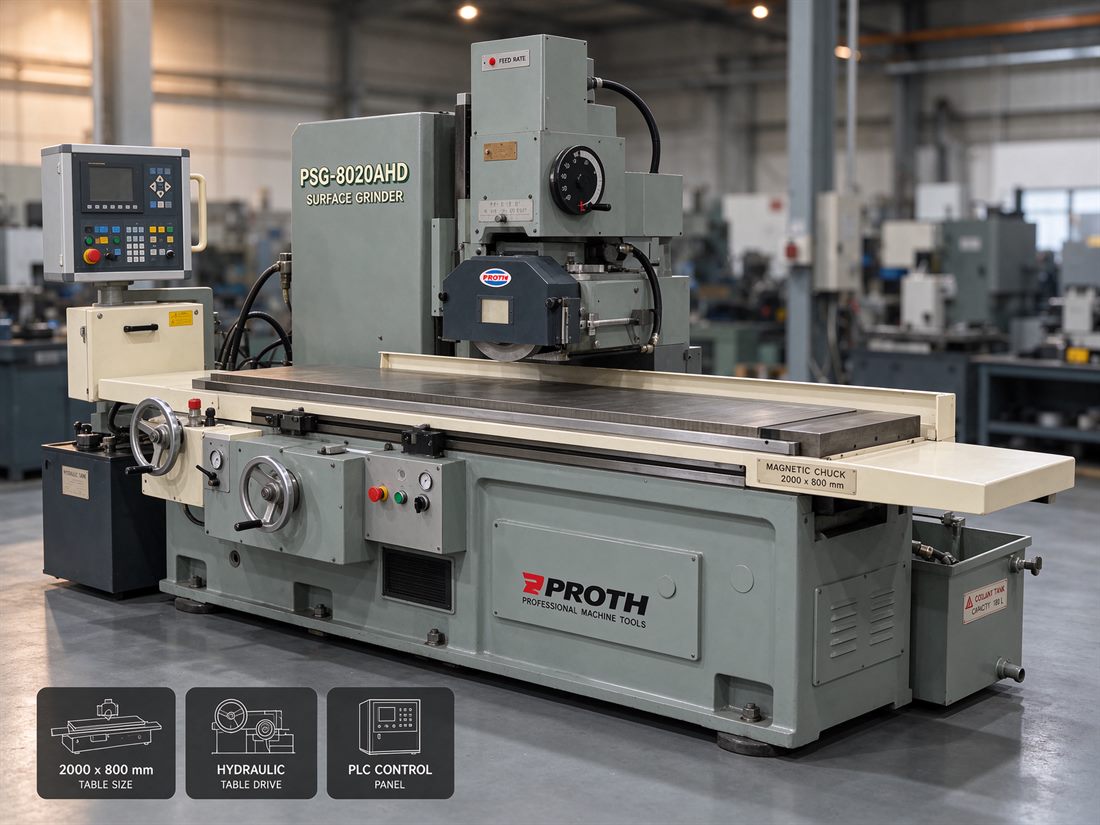
The PSG-618M manual machine is the right entry point for a shop grinding under 1,000 parts a year; the PSG-250AH is where the cycle-time saving starts to dominate. The crossover is arithmetic, not opinion — the part count and the minutes per part decide it.
FAQ
What should I charge per hour for surface grinding?
In a small shop with one operator, USD 55–70 per hour is the usual range for a hydraulic machine. Build the rate from cost, not from what competitors quote.
How much does a surface grinder cost to run per hour excluding labour?
USD 6–8 for a manual 6×18 and USD 12–18 for a hydraulic 500×250, covering depreciation, floor, power, wheels, coolant and maintenance.
Is a hydraulic surface grinder worth more than a manual one?
Above roughly 5,000 parts a year, yes: the cycle-time saving at a USD 43 hourly cost exceeds the price difference within a year or two.
How do I price a single grinding job?
Setup hours plus cycle minutes per part, multiplied by the shop rate, plus wheel consumption and a rework allowance. Never quote from cycle time alone.
Bottom line
Grinding profitability is setup time, cycle time and utilisation — not the purchase price. If you tell us the part mix and annual volume, we will run the crossover arithmetic with you and say whether a manual, hydraulic or PLC machine is the cheaper answer. Send your part mix and volume for a cost comparison.