Surface Grinder Depth of Cut: How Much Per Pass
How much you can take off in one pass on a surface grinder, by material and hardness, plus why spark-out passes matter more than the big cut.
- Depth of cut by material and hardness
- Why 0.05 mm and not 0.2 mm
- Spark-out: the pass that does the work
- Signs you are cutting too deep or too shallow
- Setting the depth on each machine type
- FAQ
- How deep can you cut in one pass on a surface grinder?
- Is 0.01 mm too little for a grinding pass?
- How many passes to remove 0.5 mm?
- Do spark-out passes really matter?
- Bottom line
On a 2.2–4 kW surface grinder with a 46–60 grit aluminium oxide wheel, 0.02–0.05 mm per pass is the working range; 0.05 mm is roughing on mild steel and 0.02 mm is a normal pass on hardened steel above 55 HRC. Above 0.05 mm the wheel cannot clear the chip before the next edge arrives, the part burns and the wheel glazes. Below 0.01 mm the wheel rubs instead of cutting, which is its own form of damage. The useful rule is: decide the total allowance, then split it into roughing passes at the top of the range plus two spark-out passes at the bottom.
Depth of cut by material and hardness
The limit is not the machine's spindle power alone, it is the chip thickness the wheel can evacuate. Harder material means thinner chips, because the force per edge rises and the wheel dulls before it clears the cut.
| Material | Hardness | Roughing DOC | Finishing DOC | Total practical allowance per setup |
|---|---|---|---|---|
| Mild steel | 150–200 HB | 0.04–0.05 mm | 0.01–0.015 mm | 0.5–1.0 mm |
| Alloy tool steel, annealed | 200–280 HB | 0.03–0.04 mm | 0.01 mm | 0.4–0.8 mm |
| Tool steel, hardened | 52–58 HRC | 0.02–0.03 mm | 0.005–0.01 mm | 0.2–0.4 mm |
| Tool steel, hardened | 58–62 HRC | 0.015–0.02 mm | 0.005 mm | 0.15–0.3 mm |
| Stainless steel | — | 0.02–0.03 mm | 0.008–0.012 mm | 0.2–0.4 mm |
| Cast iron | 170–220 HB | 0.05–0.06 mm | 0.01–0.015 mm | 0.6–1.2 mm |
| Aluminium | — | 0.05 mm (special wheel) | 0.01–0.02 mm | 0.5 mm, expect loading |
| Carbide | — | 0.01–0.015 mm | 0.003–0.005 mm | 0.1–0.2 mm |
Read the last column as the budget for a single setup. If the part needs 1.5 mm off a face, grinding is the wrong process for the first 1.3 mm — mill or planer it down while the part is soft, then grind the last 0.2–0.4 mm.
Why 0.05 mm and not 0.2 mm
The physical limit is chip clearance. A 46 grit wheel at 1,800 rpm on a 200 mm wheel has roughly 25,000–30,000 cutting edges passing a point per second. Each edge has to take a chip and clear it before the next edge arrives. At 0.05 mm depth of cut and a 12 m/min table speed, each edge is taking a chip of about 1–2 µm thickness — already close to the practical limit for aluminium oxide. Push the depth to 0.15 mm and the chip becomes 5 µm or more: the wheel cannot clear it, the forces double, the wheel glazes and the coolant cannot reach the contact zone.
That is also why a coarser wheel can take a deeper cut: 24–30 grit has far fewer edges per revolution and larger porosity, so it clears a bigger chip. If you genuinely need to remove 0.1 mm per pass, use a 24–30 grit wheel and accept Ra 1.6–3.2 µm, then finish with a second wheel.
Spark-out: the pass that does the work
A spark-out pass is a pass with the downfeed left where it is after the last cutting pass, so the wheel removes only the deflection that remains. It is the cheapest quality improvement available on a surface grinder.
- One spark-out pass at the end of a rough sequence typically removes 0.002–0.005 mm of residual deflection and cuts Ra by 30–50%.
- Two spark-out passes at 60 grit will take a Ra 0.8 µm surface to about Ra 0.4 µm on a rigid machine.
- Spark-out is not free: each pass at 12 m/min table speed over a 500 mm plate takes 8–10 seconds. Three passes per part is under half a minute.
Shops that "cannot afford" spark-out usually spend more time reworking parts that came out 0.008 mm out of parallel.
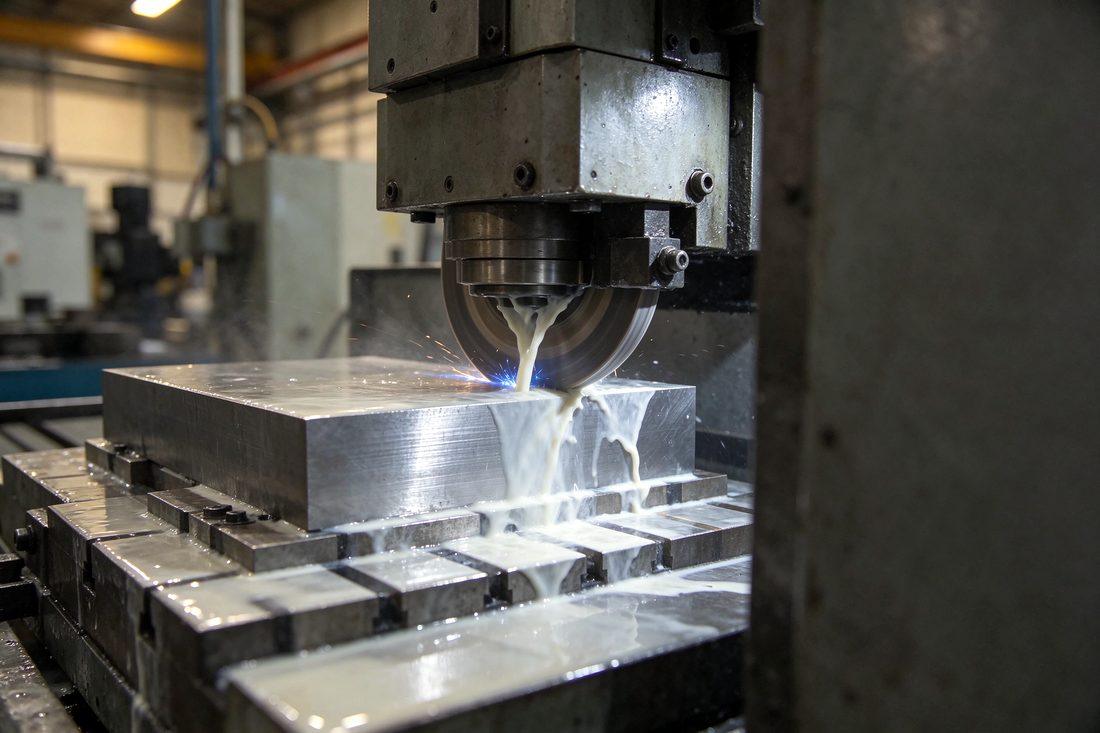
The spark pattern is the feedback loop: a full, even spark across the face means the cut is being taken; sparks concentrated at one edge mean the part is rocking.
Signs you are cutting too deep or too shallow
| What you see | What it means | What to change |
|---|---|---|
| Blue or straw temper colours on the face | Burn from excessive depth or a glazed wheel | Halve the DOC, dress, raise coolant flow |
| Wheel glazes within 20 minutes | Grade too hard for the depth you take | One grade softer (J instead of K), or reduce DOC |
| Sparks riding high off the wheel, no cut | Rubbing: DOC under 0.005 mm | Raise DOC to 0.01 mm minimum, or dress the wheel |
| Chatter pattern with regular spacing | Wheel imbalance, not depth | Balance the wheel, reduce cross feed |
| Part measures 0.01 mm thin at one edge | Table or chuck not flat; depth is being set against a moving reference | Clean the chuck, check part clamping, not the DOC |
Setting the depth on each machine type
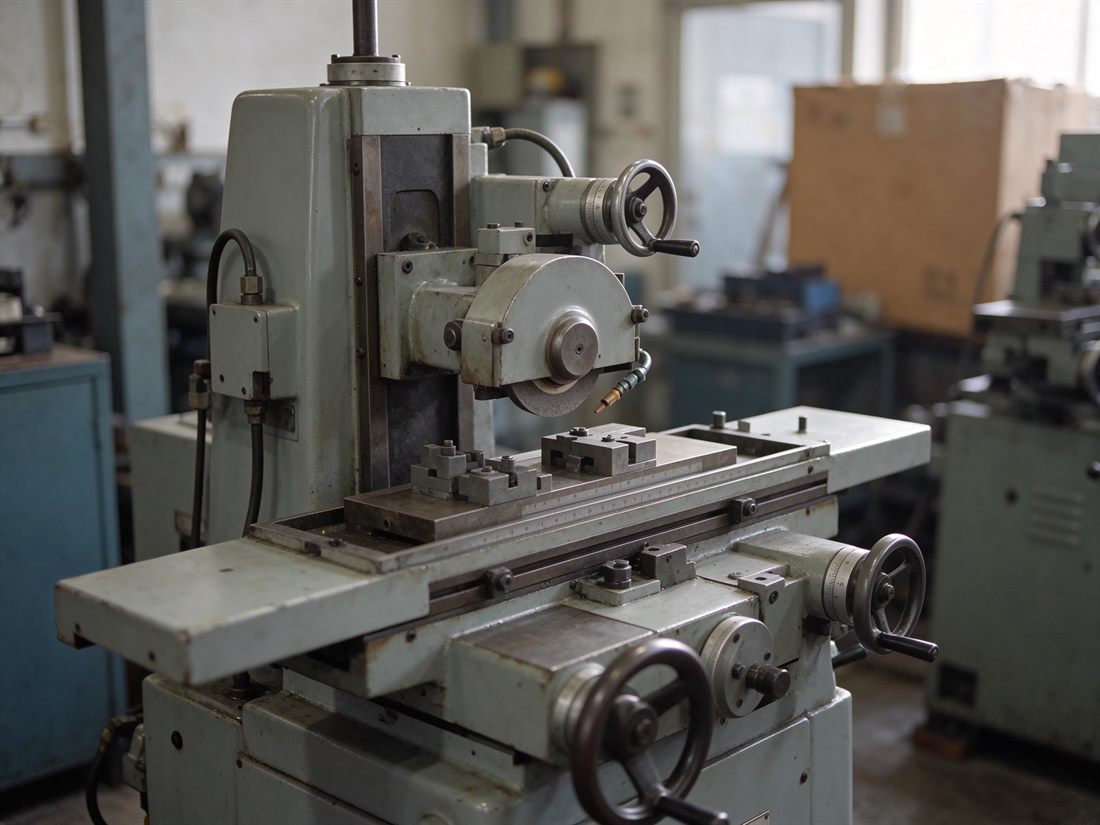
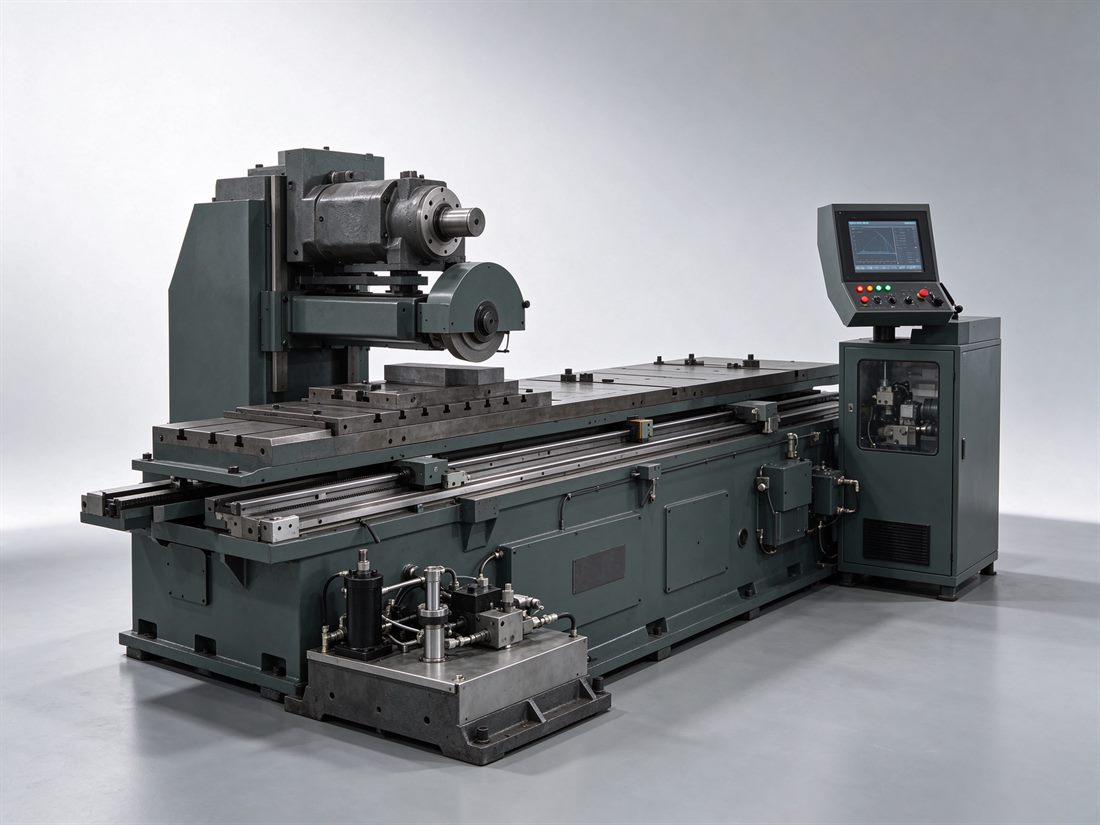
Manual machines set depth on a handwheel graduated in 0.005 mm or 0.002 mm, and the operator feels the cut. The practical discipline is to take the first pass at 0.01 mm to confirm contact, then rough at 0.03–0.04 mm, then two passes at 0.005 mm.
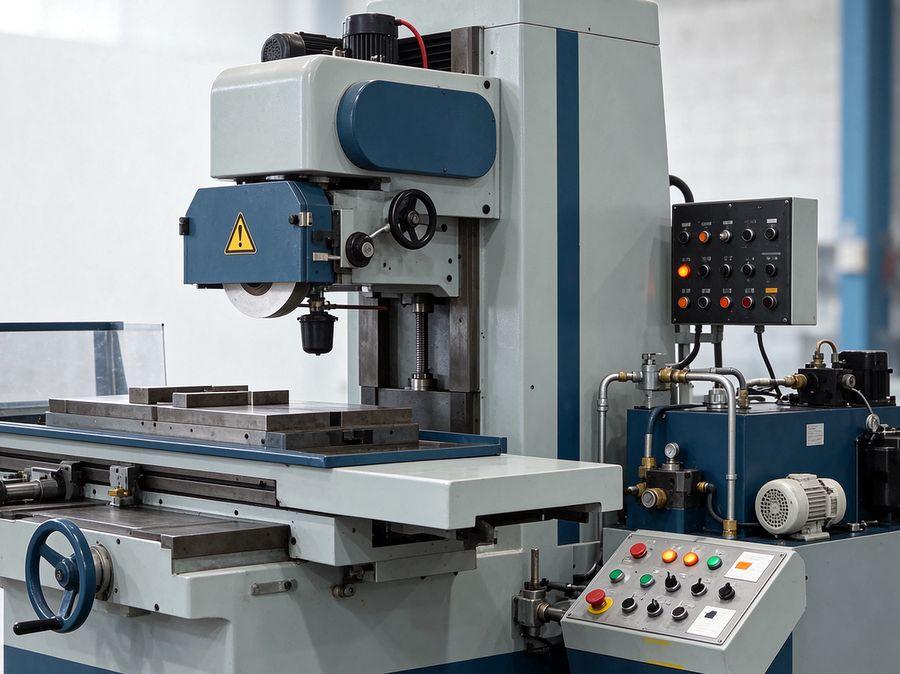
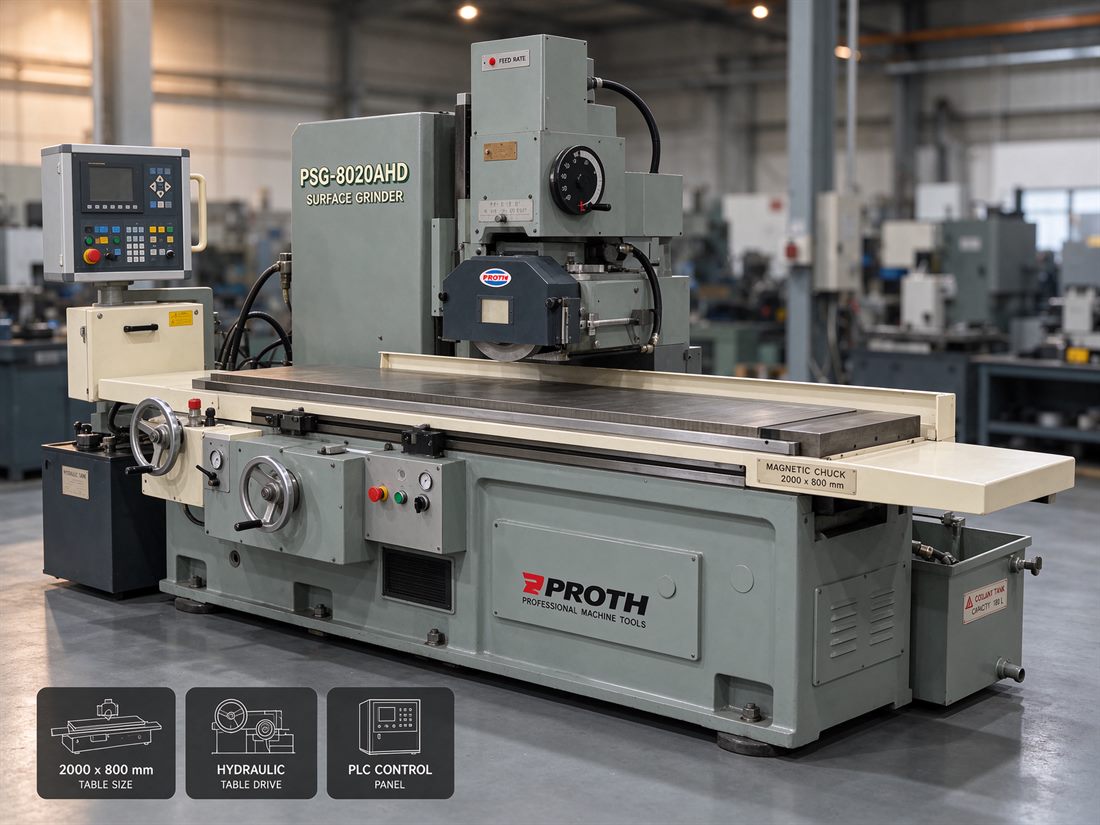
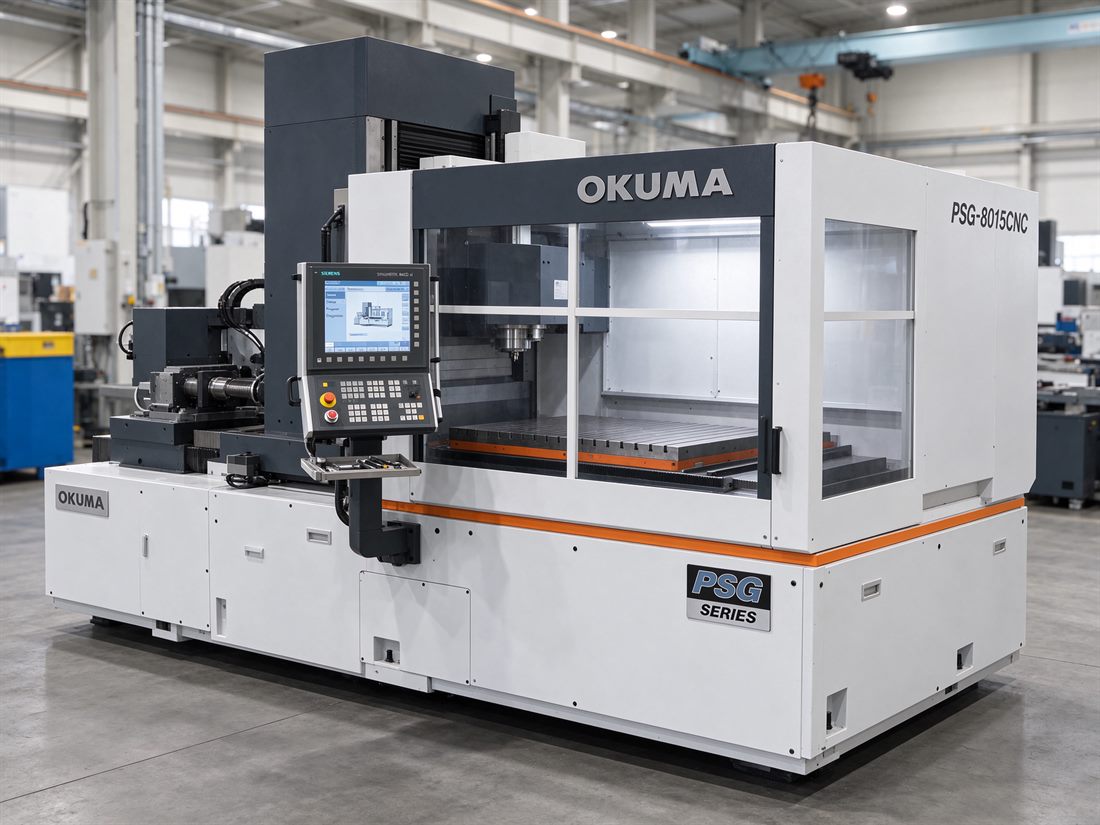
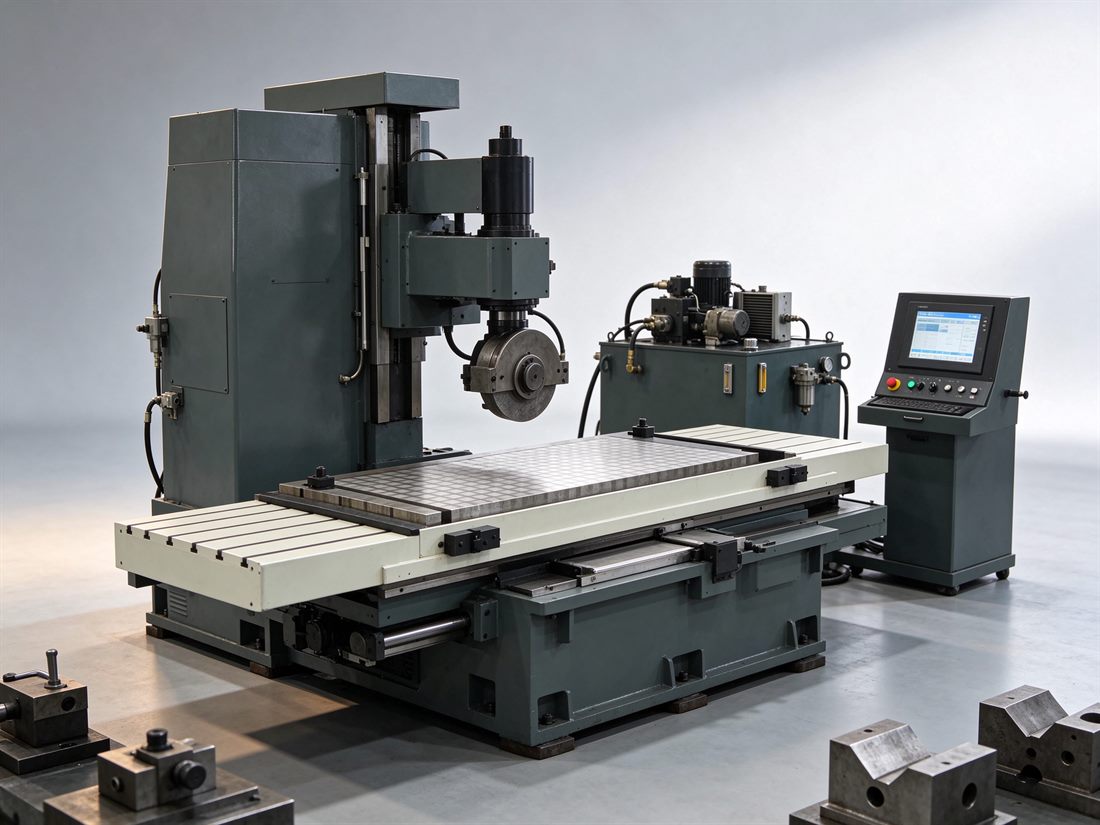
Hydraulic automatic machines such as the PSG-4080AH apply the downfeed per table cycle, so the depth per pass is set once and repeated — which is why they hold thickness better across a batch than a manual machine driven by feel. PLC and CNC machines go further: they can be programmed to take a sequence of decreasing passes and finish with defined spark-out, which is how a PSG-250SK3 CNC surface grinder holds ±0.002 mm without an operator watching each pass.
FAQ
How deep can you cut in one pass on a surface grinder?
0.05 mm on mild steel with a 46 grit wheel and 4 kW, 0.02 mm on hardened steel at 58 HRC. Above that the wheel cannot clear the chip and the part burns.
Is 0.01 mm too little for a grinding pass?
0.01 mm is a valid finishing pass but a poor roughing pass: the wheel rubs, glazes and generates heat without removing much material. Rough at 0.03–0.04 mm, then finish at 0.01.
How many passes to remove 0.5 mm?
About 14 roughing passes at 0.035 mm plus two spark-out passes on mild steel — roughly 16 table cycles. On hardened steel at 0.02 mm, nearer 27 passes.
Do spark-out passes really matter?
Yes. One spark-out pass removes 0.002–0.005 mm of residual deflection and cuts Ra by 30–50% for ten seconds of machine time.
Bottom line
Depth of cut is a chip-clearance limit, not a power limit: keep roughing at 0.02–0.05 mm, finish at 0.005–0.015 mm, and always spark out. If you send us the allowance, the material and the tolerance, we will tell you the pass strategy and whether your spindle has the power for it. Get a pass plan for your part.