How to Dress a Grinding Wheel Correctly (and How Often)
Dress depth, pass count, diamond tool angle and interval — the dressing procedure that keeps a surface grinder cutting instead of rubbing.
Why dressing is the whole game
A glazed wheel rubs. Rubbing work-hardens the surface, raises the temperature and produces a finish that looks acceptable but measures wrong. Dressing exposes fresh grit — that is the entire purpose, and it is more important than spindle power.
The procedure
- Stop the coolant flow to the wheel, keep the table clear, and mount the dresser on the chuck or in the fixture.
- Start the spindle and let it reach full speed.
- Set the diamond 0.02 mm into the wheel and traverse across the face at a steady feed. Three passes.
- Run a fourth pass at zero depth to clean the face.
- Re-set the wheel zero to the work surface — dressing removes material from the wheel, so the height reference shifts.
Diamond angle and position
Use a 60° single-point dresser, tilted 10–15° in the direction of rotation. A diamond that is dragged rather than tilted wears a flat spot and dresses slowly. Replace the diamond when it starts to spark rather than cut.
How often?
| Operation | Dress interval |
|---|---|
| Precision work, 0.002–0.005 mm | Every 20–30 minutes of grinding |
| General die plate flatting | Every 45–60 minutes, or when the spark pattern changes |
| Carbide with diamond wheel | Every 15–20 minutes with a SiC stick |
| Aluminium | Every 30 minutes, coarse open wheel |
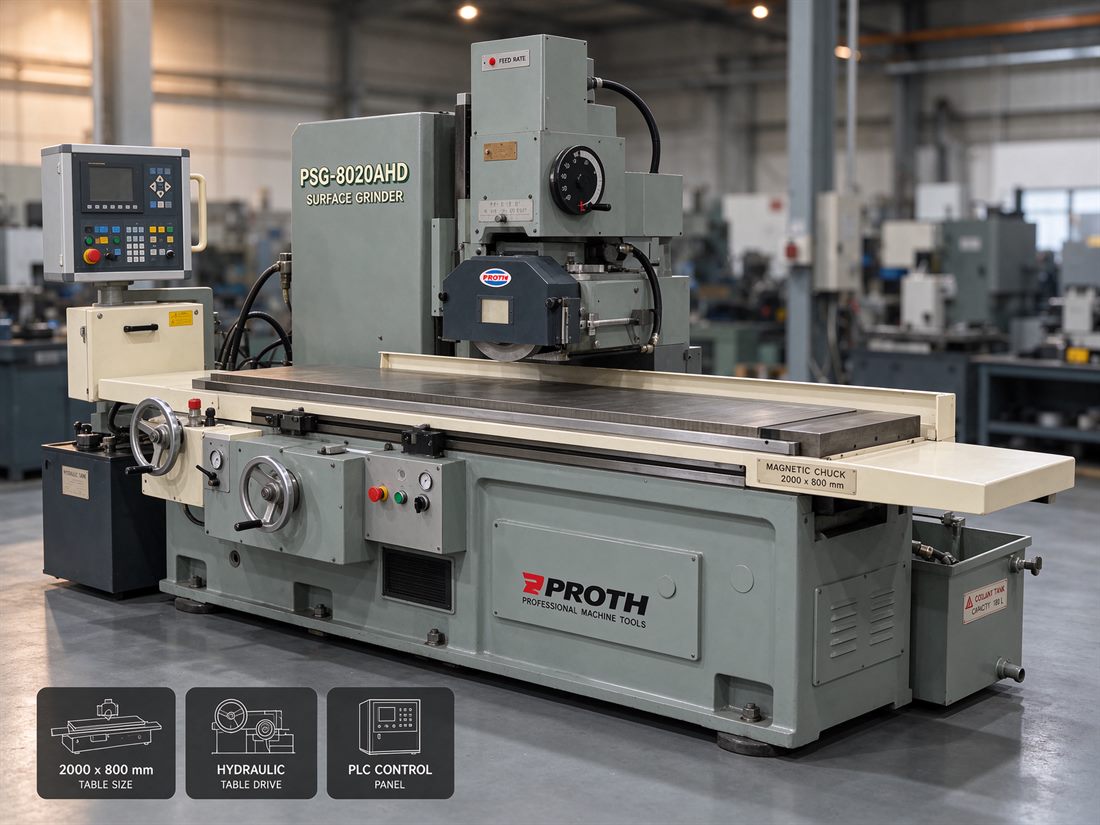
On PLC and CNC machines, dressing is a programmed interval with automatic compensation — the machine dresses on time, every time, which is exactly why batch consistency improves.
After dressing
Check wheel balance if the wheel is over 250 mm. Re-balance on a stand, not on the spindle. An unbalanced wheel after dressing shows up as a taper across the part.
Need a machine recommendation for this job? Send the drawing and tolerance to our application engineers — reply within 24 hours.