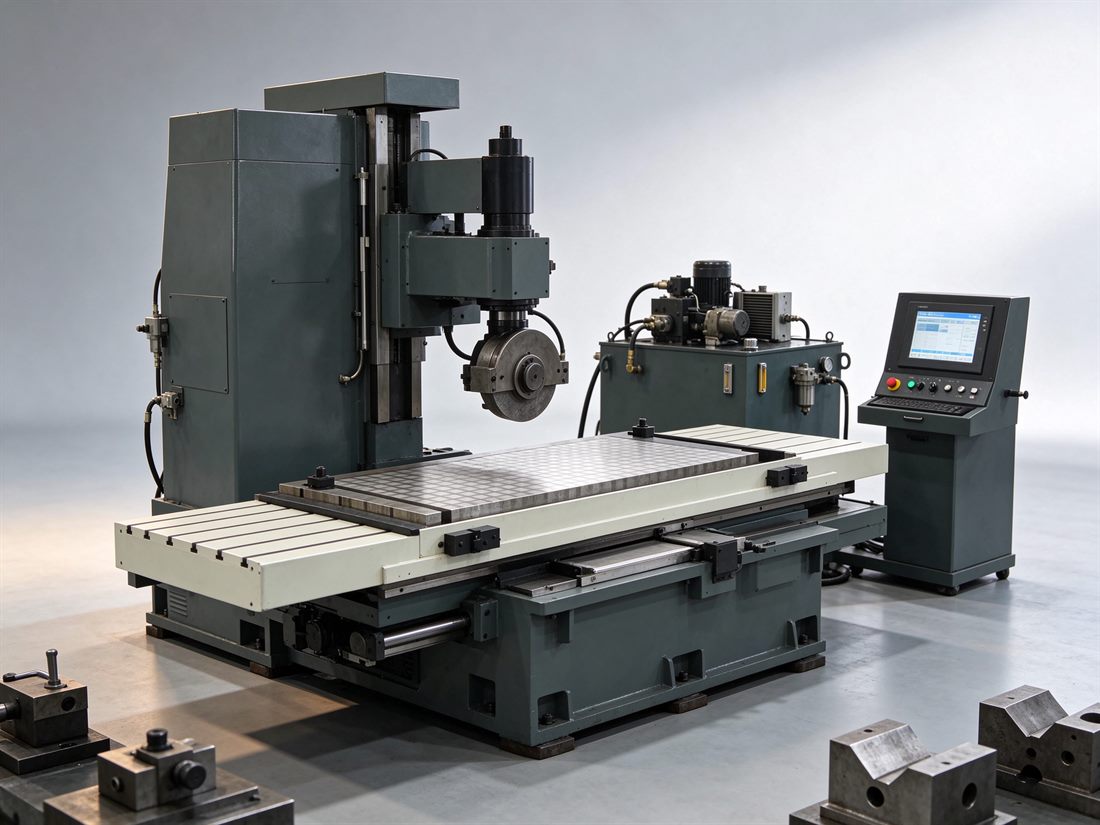
Surface Grinder for Knife Making: Grits and Passes
How a surface grinder fits knife making: grits for blanks and bevels, why it beats a belt grinder on geometry, and holding thin blades without bending.
- Where each machine wins
- Grit sequence for a blade
- Holding a blade without bending it
- A jig that makes bevels repeatable
- What this means for machine choice
- FAQ
- Can you make knives with a surface grinder?
- What grit should I use on a surface grinder for knife making?
- Will a surface grinder burn a knife blade?
- How thin a blade can I grind on a magnetic chuck?
- Bottom line
For knife making, a surface grinder does three jobs better than any belt grinder: flattening the as-rolled or as-forged blank, setting a true bevel flat on a jig, and thinning a tang or a distal taper to a measured thickness. Use 46–60 grit aluminium oxide for stock removal on annealed steel and 120–180 grit for the passes before hand finishing; expect 0.02 mm flatness on a 4 mm blade. It will not replace a belt grinder for profiling curves — it replaces it wherever the geometry has to be flat or parallel.
Where each machine wins
A belt grinder removes material against a platen, and the platen is a reference surface with flatness of its own; a surface grinder removes material against a wheel while the part sits on a chuck ground flat. That difference is why a surface grinder holds a bevel angle to about 0.1° while belt grinding drifts with platen wear and belt pressure.
The surface grinder is poor at anything but planes: a recurve, a hollow grind and a plunge line all want a contact wheel. The honest workflow for a forged blade is belt grind the profile and rough bevel, surface grind the blank and the bevel flats, then hand finish.
Grit sequence for a blade
| Stage | Grit | Depth of cut | What it achieves |
|---|---|---|---|
| Flatten as-forged or as-rolled blank | 46 | 0.03–0.05 mm | Removes scale, establishes a flat reference |
| Square the blank, set thickness | 46–60 | 0.02–0.03 mm | Parallel faces within 0.02 mm |
| Establish bevel flats on a jig | 60 | 0.02 mm | Angles within 0.1°, flats within 0.05 mm |
| Refine before hand finishing | 120 | 0.01–0.015 mm | Removes the 60 grit scratch pattern |
| Pre-polish flat | 180–220 | 0.005–0.01 mm | Laps out in minutes instead of hours |
Two cautions. Do not chase grit past 220 on a surface grinder for a blade: a 0.05 µm finish belongs on a stone or a lapping plate, and the wheel time is better spent making geometry exact. And blades above 58 HRC do not belong on aluminium oxide — grind before hardening, or switch to CBN.
Holding a blade without bending it
A 4 mm blade on a magnetic chuck is a spring. It conforms to any gap when magnetised and springs back when released, so the flatness you measured disappears. Three fixes that work:
- Stone and degrease both faces before clamping. A single burr on a 4 mm blade is a visible bend.
- Block thin blades on parallels and grind them as a supported plate rather than a free span.
- Reduce cross feed to 0.3 of the wheel width on finishing passes, halving the side load that causes the deflection.
At 2 mm or below, magnetic work is marginal: grind between two sacrificial plates bolted together, or use a vacuum plate. A bare 2 mm blade on a 20 mm pole pitch chuck will measure 0.03 mm flatness and visibly rock afterwards.
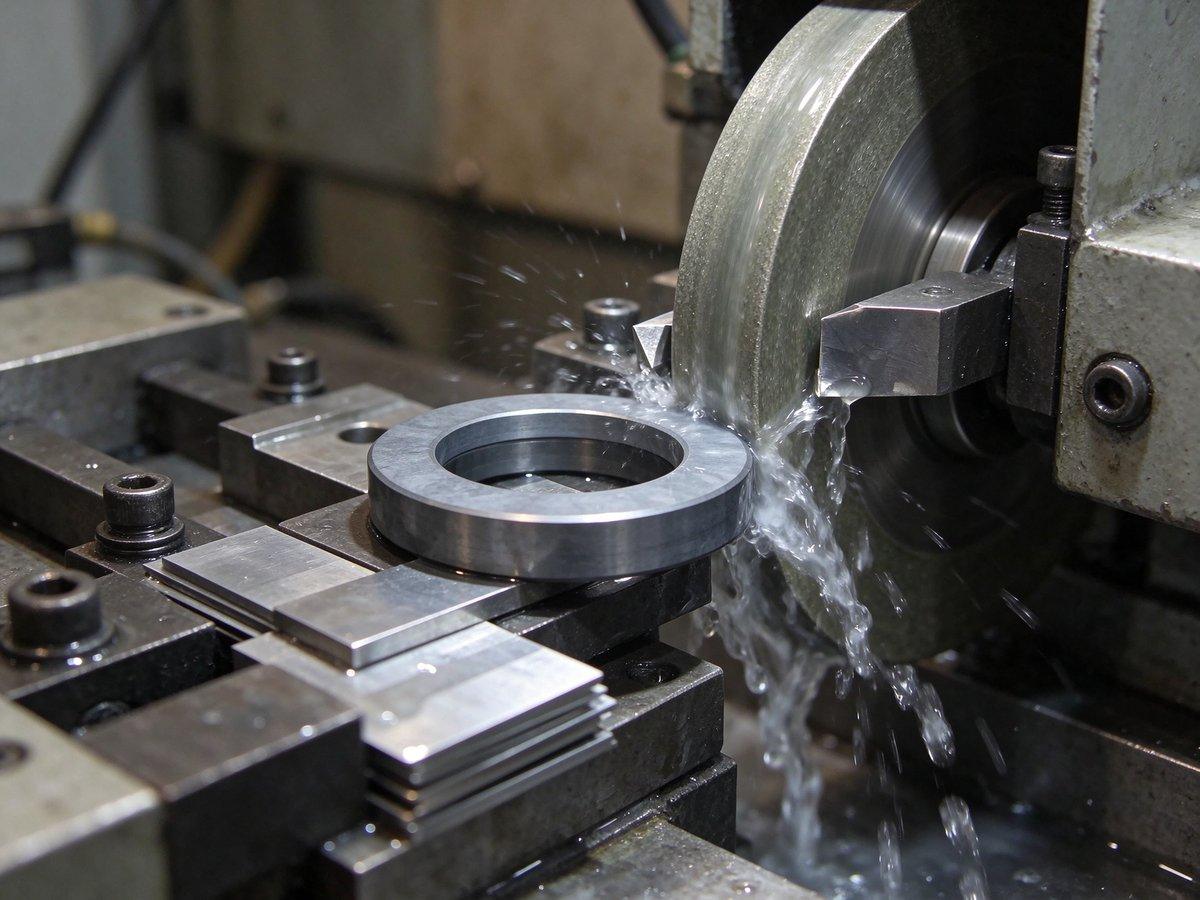
Flat, parallel blade blanks come off the chuck ready for hand finishing, with the bevel flats already true.
A jig that makes bevels repeatable
The jig is the whole trick. A magnetic sine table, or a simple angle block with a stop, lets you grind one bevel flat, index the blade 180° and grind the other, and come back to the first bevel for a second pass without re-establishing the angle by feel. What the jig buys you is not speed but repeatability: the second blade is identical to the first within 0.1°. For a maker producing a run of ten knives, that is the difference between a set and ten individual jobs.
Keep the jig's own face flat — stone it as often as the chuck. A jig that has picked up a burr transmits that error to every blade, and a bevel that is 0.2° off is visible to a customer who has handled better work.
Steel choice changes the pass strategy more than most makers expect. Simple carbon steels at 58–60 HRC grind freely with 60 grit at 0.02 mm passes. Stainless grades such as 440C or AEB-L work-harden and smear under a heavy pass, so they want one grade softer, a shallower 0.01–0.015 mm cut and constant flood coolant — if the wheel leaves a smeared streak, the depth is too high rather than the grit too fine. Powder-metallurgy steels are the most forgiving of the three: clean, fine-grained, and they hold a bevel flat without the burn risk of a smeared stainless. Adjust the depth to the steel before you adjust the grit, because grit governs finish and depth governs whether the steel cuts or smears.
What this means for machine choice
Knife work is small, precise and often one-off, so the machine that fits is a 6 × 18 or 450 × 200 mm manual grinder with a fine-pole chuck. The PSG-618M manual surface grinder at 450 × 150 mm handles blades up to 300 mm and gives the operator direct feel on a 0.005 mm downfeed, which matters because a blade removes fast and burns quickly with too much depth. For longer kitchen blades and 600 mm blanks, the PSG-1020M at 500 × 250 mm keeps the whole blade in one clamp instead of two setups.
If blade making is a business rather than a hobby, the constraint moves from precision to repeatability: a hydraulic machine holds the same pass all day, and a PSG-250AH class machine with a fine-pole chuck will produce identical bevel flats across a batch of fifty.
FAQ
Can you make knives with a surface grinder?
Yes, for flats: blank flattening, thickness, bevel flats and tangs. Profiling curves and plunge lines still want a belt grinder.
What grit should I use on a surface grinder for knife making?
46–60 for stock removal on annealed steel, 120–180 for the finishing passes. Above 220 you are paying wheel time for finish that a stone does better.
Will a surface grinder burn a knife blade?
It can, with too much depth of cut — a 4 mm blade has almost no heat sink. Keep depth at 0.02 mm or less on the bevel and keep coolant on the contact zone.
How thin a blade can I grind on a magnetic chuck?
4 mm is comfortable with a fine-pole chuck. Below 2 mm expect warp; use a fixture or grind between sacrificial plates.
Bottom line
A surface grinder makes knife geometry repeatable, which is what separates a set from ten individual attempts. Tell us the blade length, thickness, steel and how many you make per month, and we will match the table size and chuck pitch to the work. Ask for a knife-making setup recommendation.