Magnetic Chuck Not Holding: 6 Causes and Fixes
Why a magnetic chuck stops holding on a surface grinder: six real causes ranked by frequency, with the test that identifies each in minutes.
- Cause 1: the air gap you cannot see
- Cause 2: pole pitch versus part thickness
- Cause 3: the controller is not delivering
- Cause 4: never fully demagnetised
- Cause 5: worn or breached top plate
- Cause 6: demagnetising while the part is clamped
- The systematic check, in order
- When the part is thin, no chuck is enough
- FAQ
- Why did my magnetic chuck stop holding suddenly?
- Can I increase holding force by leaving the chuck on longer?
- How much holding force do I need for grinding?
- Can a weak magnetic chuck be repaired?
- Bottom line
A magnetic chuck stops holding for six reasons, and five of them are diagnosable in under ten minutes: an air gap under the workpiece, a pole pitch too coarse for the part thickness, a controller not delivering full current, a chuck left magnetised between jobs, a worn or breached top plate, or a demagnetising cycle run while the part was still clamped. The test that separates them is a 0.02 mm feeler gauge and a spring scale — measure the gap first, because a 0.1 mm air gap cuts holding force by more than half.
Cause 1: the air gap you cannot see
Holding force falls roughly with the square of the gap. A permanent magnetic chuck rated at 80 N/cm² with the workpiece directly on the plate may deliver 30 N/cm² at a 0.1 mm gap and under 10 N/cm² at 0.3 mm. The gap is usually invisible: a burr from the previous operation, a film of dried coolant, a patch of scale on hot-rolled stock, or a part that was never deburred.
Test: clamp the part, magnetise, and try to slide a 0.02 mm feeler under the edge. If the feeler enters anywhere, you have found it. Stone the part face and the chuck face, degrease both, and repeat. In shop-floor practice this accounts for roughly four out of ten "the chuck is weak" complaints.
Cause 2: pole pitch versus part thickness
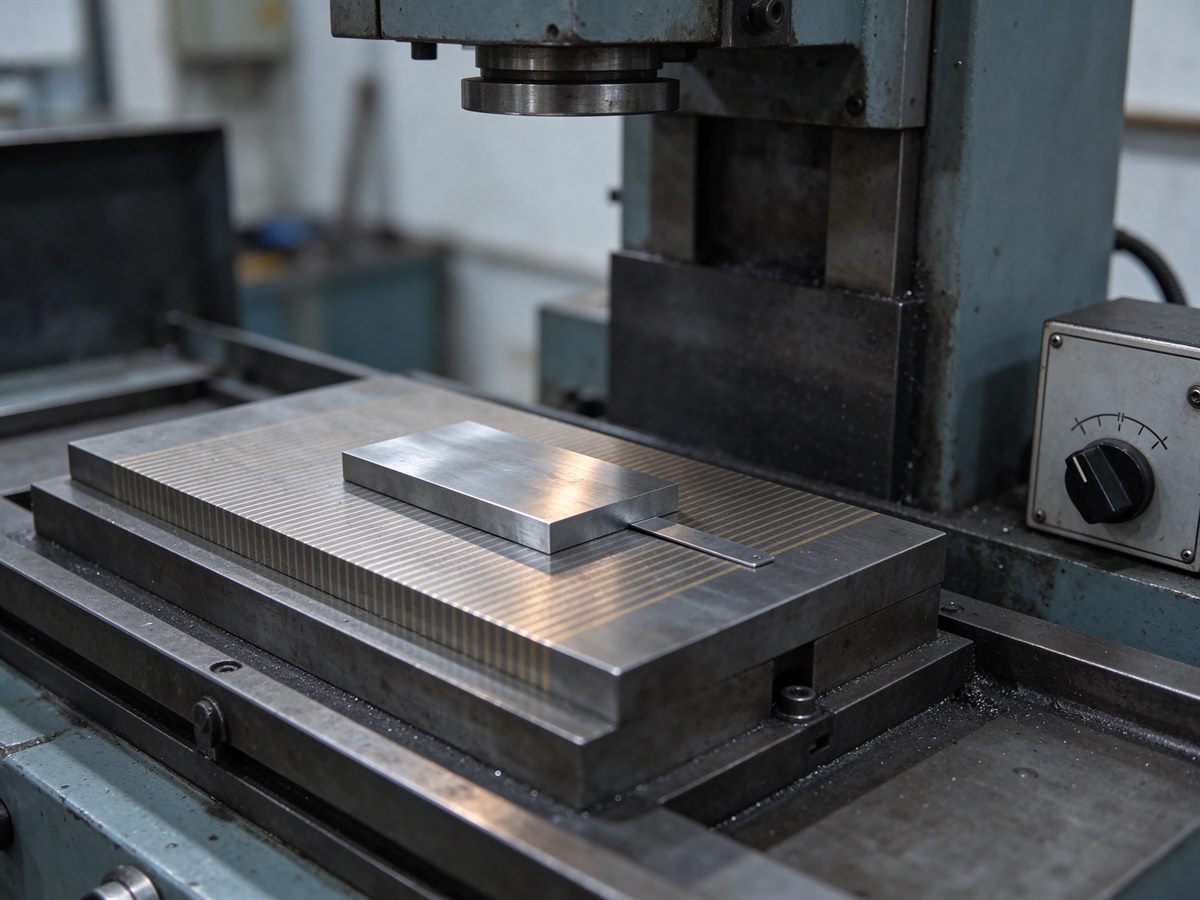
Pole pitch — the distance between adjacent north and south poles — decides how much flux reaches through the part. Flux needs thickness to complete its circuit; a 20 mm pitch through a 1 mm blade leaves most of the flux in the air beside the part.
| Part thickness | Pole pitch that works | Holding force you can expect |
|---|---|---|
| Over 15 mm | 20–25 mm | Full rated force |
| 8–15 mm | 12–16 mm | 80–95% of rated |
| 4–8 mm | 8–12 mm | 60–80% of rated |
| 2–4 mm | 4–6 mm fine pole | 40–60% of rated |
| Under 2 mm | 2–3 mm fine pole, or a fixture | 25–40%, with warping risk |
Test: measure the part, then read the pole pitch from the stripe pattern on the chuck face. If the ratio is worse than the table above, the answer is a fixture or a fine-pole chuck, not more current.
Cause 3: the controller is not delivering
On an electromagnetic chuck, holding force is proportional to coil current. A failed bridge rectifier, a tired transformer, or a controller set to a partial magnetising cycle will hold enough to feel "on" and not enough to survive a grinding force.
Test: clamp a 100 × 100 × 20 mm steel block, magnetise, and pull it sideways at 45° with a spring scale. Compare with the rated release force for that part size. A 30–50% shortfall points at the controller or the coil, not the face. Check the DC output during the magnetise phase; it should sit within 5% of rated.
Cause 4: never fully demagnetised
A chuck left magnetised for weeks retains a residual field that fights the next cycle unevenly: the part feels clamped, but the residual varies across the face, so the part rocks microscopically and grinds a taper. This is the defect that masquerades as machine geometry.
Test: with the chuck off, use a gauss meter or sprinkle fine iron filings. Residual above 3–5 gauss across the working face means the demagnetising cycle is not completing. Run it twice with no part on the chuck and re-measure.
Cause 5: worn or breached top plate
Most chucks carry a thin stainless or brass top plate over the pole pieces. Coolant, grit and years of stoning wear it through at the edges. Once breached, coolant enters the pole gaps, corrosion builds, and holding force drops locally — you feel it as a part that clamps at one end and slides at the other.
Test: stone the face and inspect at a low angle under bright light. Cracks show as dark lines, wear-through as bright metal patches. A breached plate needs re-plating or replacement; no amount of current restores it.
Cause 6: demagnetising while the part is clamped
Running a demagnetising cycle with a part still on the chuck leaves the part magnetised, so swarf sticks to it and the next face starts contaminated. On some controllers the demagnetise phase also partly discharges the chuck state, so the next magnetising cycle is weaker. Release the part first, then demagnetise it off the chuck.
The routine that removes the operator variable: magnetise, grind, switch off, release, demagnetise off the chuck. A controller with a dedicated demagnetising cycle enforces the sequence rather than leaving it to habit.
Pole pitch is visible as a stripe pattern on the chuck face; comparing it with part thickness tells you in seconds whether holding force is even possible.
The systematic check, in order
| Step | What to do | Time | If it fails |
|---|---|---|---|
| 1 | Feeler under the part edge while magnetised | 1 min | Deburr and stone both faces |
| 2 | Compare part thickness with pole pitch | 2 min | Fixture or fine-pole chuck |
| 3 | Pull test with a spring scale at 45° | 5 min | Controller or coil diagnosis |
| 4 | Residual field with the chuck off | 3 min | Run the demagnetise cycle twice |
| 5 | Stone and inspect the top plate | 3 min | Re-plate or replace |
| 6 | Audit the demagnetise routine | 1 min | Rewrite the SOP |
Work down the list. The overwhelming majority of cases resolve at steps 1 and 2, and only after both pass does the controller become the suspect.
When the part is thin, no chuck is enough
Below 2 mm a magnetic chuck is the wrong tool, and the honest answer is a fixture or a vacuum plate. Thin parts bend into the field before the wheel touches them, so the chuck is grinding a curved part and releasing it straight — flatness out of tolerance regardless of what the holding force reads. Block the part on parallels and grind it in a fixture, or use double-sided grinding for volume.
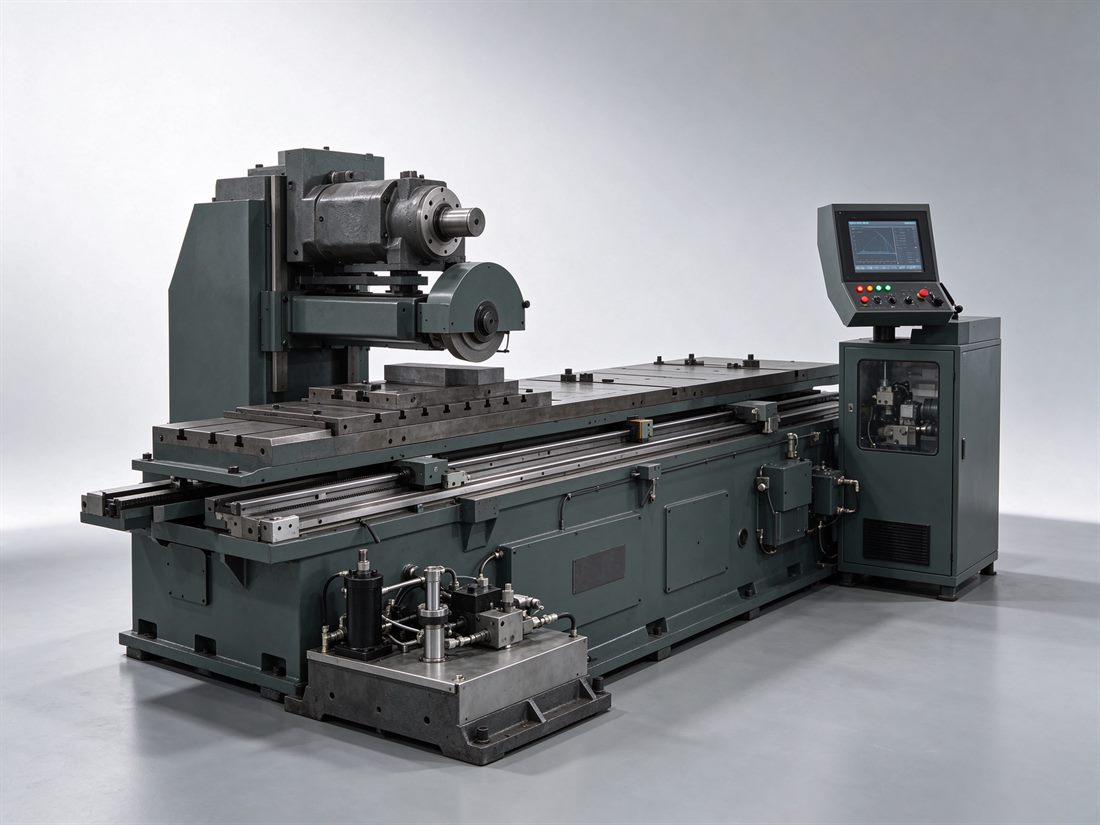
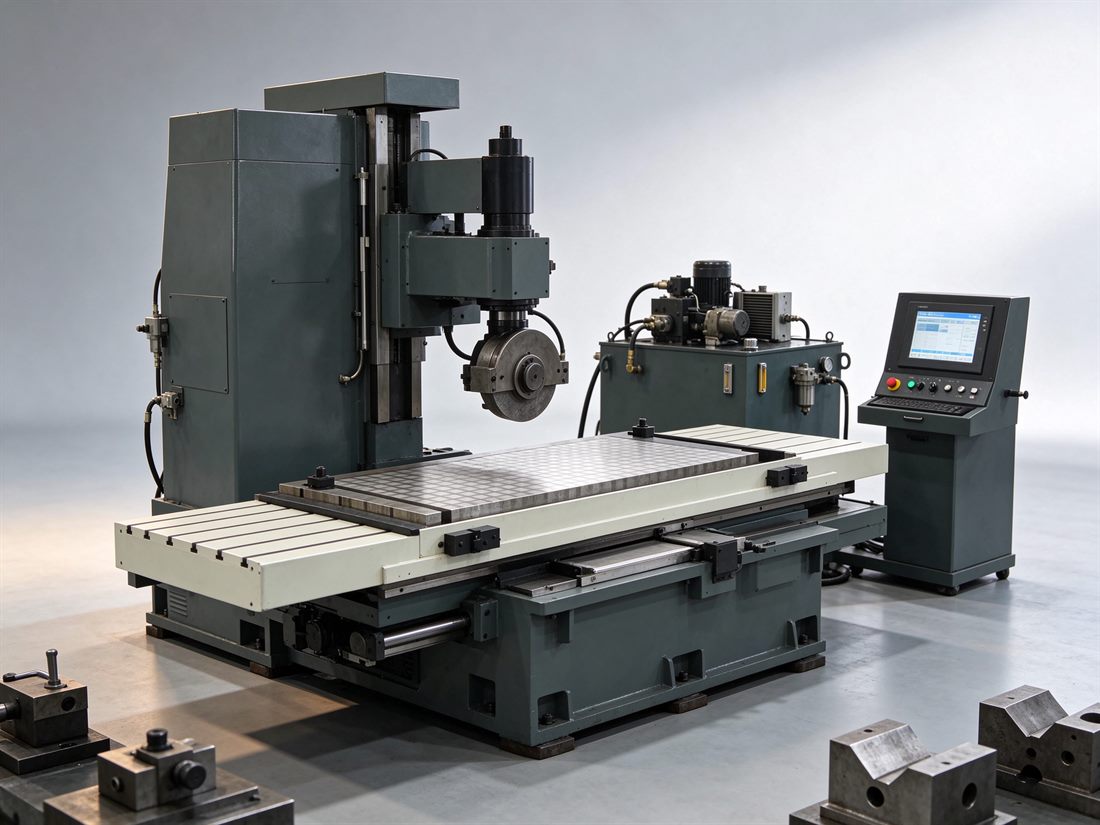
If thin work is a large share of your output, settle this before choosing a machine. A 500 × 250 mm hydraulic machine in the PSG-250AH class with a fine-pole chuck handles 3 mm plates all day; the same machine with a 20 mm pitch will not.
FAQ
Why did my magnetic chuck stop holding suddenly?
Almost always an air gap: a burr, dried coolant or a scale patch. A sudden change is rarely the coil — check the gap with a 0.02 mm feeler first.
Can I increase holding force by leaving the chuck on longer?
No. A permanent chuck reaches full force in under a second; an electromagnetic chuck reaches full current in about a second too. Holding longer only heats the coil.
How much holding force do I need for grinding?
Grinding tangential force is small, typically 5–15 N for a 0.03 mm pass. A chuck giving 30 N/cm² on a 100 × 100 mm part delivers roughly 3,000 N, so the real limits are part rigidity and the air gap.
Can a weak magnetic chuck be repaired?
Yes if the top plate is breached or the controller failed; no if the pole pieces are corroded through — which is why filtration and stoning the face matter.
Bottom line
Nine out of ten weak-chuck complaints come down to a gap or a pole pitch mismatch, and both are measurable in minutes. Send us the part thickness, the chuck pitch and your pull-test reading, and we will tell you whether the chuck is at fault or the part is simply too thin for magnetic work. Send the chuck and part details.