Grinding Sludge and Coolant Filtration: Keep It Cutting
Why grinding sludge ruins finish and wheel life, how much a tank holds, which filtration actually removes it, and the maintenance interval that works.
- What sludge actually is
- How much sludge a surface grinder produces
- The filtration options, honestly compared
- Coolant chemistry: the part nobody checks
- The maintenance routine that holds
- What this costs and what it saves
- FAQ
- How often should I change surface grinder coolant?
- Does a magnetic separator remove grinding sludge?
- Why is my wheel loading even with clean coolant?
- Can I just use a bigger tank instead of a filter?
- Bottom line
Unfiltered grinding coolant returns 1–3 kg of sludge per 1,000 litres to the wheel every hour, and that sludge is what plugs wheel porosity and scores ways. The fix is a two-stage system — a settling tank plus a magnetic separator for ferrous work, or a paper/centrifugal filter for non-ferrous — and a cleaning interval in weeks, not years. A grinding shop that filters properly sees wheel life up 20–40% and finish failures drop to near zero.
What sludge actually is
Grinding sludge is a mixture of metal particles, abrasive fragments from the wheel, and the bond material that held the abrasive. The particles are small — 1–20 µm for most of the volume — which is exactly the size range that passes through a coarse screen and stays suspended in coolant.
Three consequences follow from that particle size. Sludge does not settle quickly, so a plain tank returns it to the wheel. It plugs the porosity of a wheel, which is loading. And when it reaches the ways, it acts as a lapping compound on the surfaces the machine's accuracy depends on.
| Sludge component | Typical share of mass | Damage it does |
|---|---|---|
| Work material (steel, cast iron) | 55–70% | Plugs wheel porosity, wears ways, rusts |
| Aluminium oxide or SiC abrasive | 20–30% | Acts as loose abrasive on ways and chuck face |
| Bond and wheel filler | 5–10% | Raises coolant pH, shortens coolant life |
| Coolant degradation products | Tramp oil, bacteria | Smell, skin irritation, corrosion |
How much sludge a surface grinder produces
A useful working figure: removing 1 cm³ of steel produces about 8 g of swarf, of which most becomes sludge because grinding chips are too fine to be captured by a chip conveyor. A machine removing 0.2 cm³/min in continuous production generates roughly 100 g per minute of grinding — 6 kg per hour.
In practice most shops run intermittently, so measure rather than calculate: dip the tank with a rod at the start and end of a week. Sediment over 5 mm at the bottom of the tank means the filtration is not keeping up.
| Duty | Sludge per week (estimate) | Tank size that works | Clean interval |
|---|---|---|---|
| Toolroom, 10 h/week | 1–3 kg | 30–60 L | Every 4–6 weeks |
| Job shop, 40 h/week, one machine | 10–25 kg | 80–120 L | Every 2–3 weeks |
| Production, 2 shifts | 50–100 kg | 200–400 L with separator | Weekly sludge removal |
| Heavy stock removal | Over 100 kg | Central system with conveyor | Continuous |
The filtration options, honestly compared
| Method | Removes | Cost | Best for | Weakness |
|---|---|---|---|---|
| Settling tank only | Particles over 50 µm, slowly | Free (it is the tank) | Very light duty | Returns 60–80% of fines to the wheel |
| Magnetic separator | Ferrous particles down to 5–10 µm | USD 150–400 | Steel and cast iron grinding | Nothing for aluminium, carbide or abrasive |
| Paper band filter | All particles over 5–10 µm | USD 300–700 plus paper | Mixed materials, fine finishing | Consumable cost, needs attention |
| Centrifugal separator | Down to 3–5 µm | USD 600–1,200 | Production, non-ferrous | Higher purchase cost |
| Hydrocyclone | 10–20 µm | USD 200–500 | High flow, cheap retrofit | Poor on fine or light particles |
| Bag or cartridge filter | Down to 1–5 µm | USD 100–300 | Polishing the coolant before the nozzle | Clogs quickly without pre-filtration |
The practical, affordable combination for a single surface grinder is a settling tank plus a magnetic separator, with a bag filter on the pump outlet. That combination removes the ferrous mass and the coarse abrasive for a few hundred dollars and it is what most shops should install first.
Coolant chemistry: the part nobody checks
Filtration solves the solids problem. It does not solve the chemistry, and the chemistry is what makes coolant smell, rust parts and irritate skin.
- Concentration drift: drag-out and water top-up both change concentration. Check with a refractometer weekly; 5–8% for steel, 8–12% for aluminium.
- Tramp oil: hydraulic leaks and way oil accumulate on the surface. Skim it, or the coolant goes rancid and the fines stop settling.
- pH: below 8.5 promotes bacteria and rust; above 9.5 attacks aluminium and skin. A dip strip costs pennies.
- Bacteria: a rancid smell is a colony. A biocide or a full change is the fix; adding more coolant to a foul tank only feeds it.
Coolant life in a filtered, monitored tank is typically 6–12 months. Unfiltered, 1–3 months. The difference in cost is usually larger than the price of the separator.
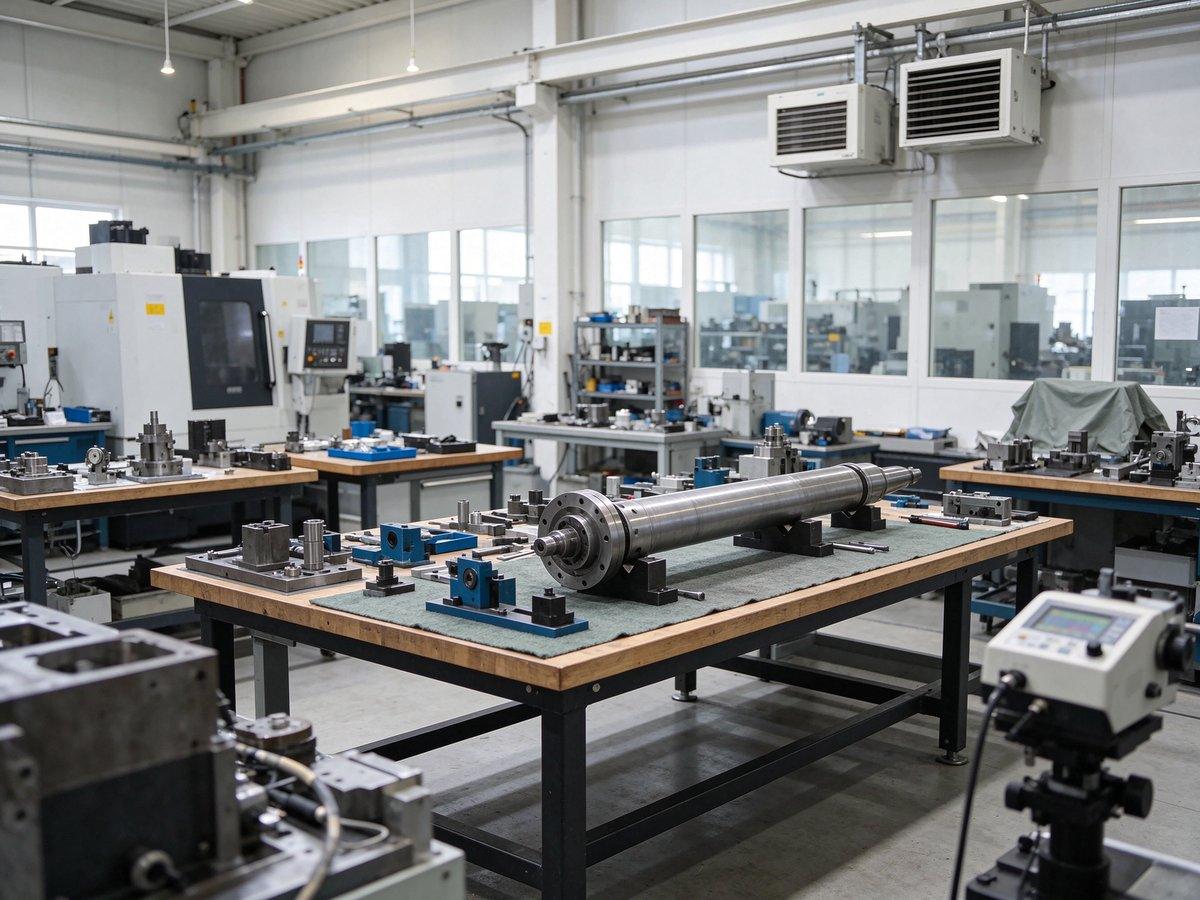
Clean coolant is a process requirement, not housekeeping: the assembly bench beside a grinding cell is only as clean as the tank that feeds it.
The maintenance routine that holds
| Interval | Action | Time |
|---|---|---|
| Every shift | Check flow at the nozzle, skim tramp oil | 2 min |
| Weekly | Refractometer reading, dip test for sediment, clean the separator | 15 min |
| Every 2–4 weeks | Remove sludge from the settling zone, top up with mixed coolant | 30 min |
| Quarterly | pH and bacteria check, replace bag filter | 20 min |
| Every 6–12 months | Full drain, tank clean, fresh charge | 2–4 h |
The single highest-value habit is the weekly refractometer reading. Nearly every coolant failure traces back to a concentration that drifted for a month unnoticed.
What this costs and what it saves
A magnetic separator plus a bag filter costs USD 250–500 installed. The savings on a single machine running 40 hours a week are typically: wheel life up 20–40% (USD 300–600 a year), coolant changes down from four to one or two a year (USD 200–400), and finish rework down by a factor that is hard to measure but easy to notice.
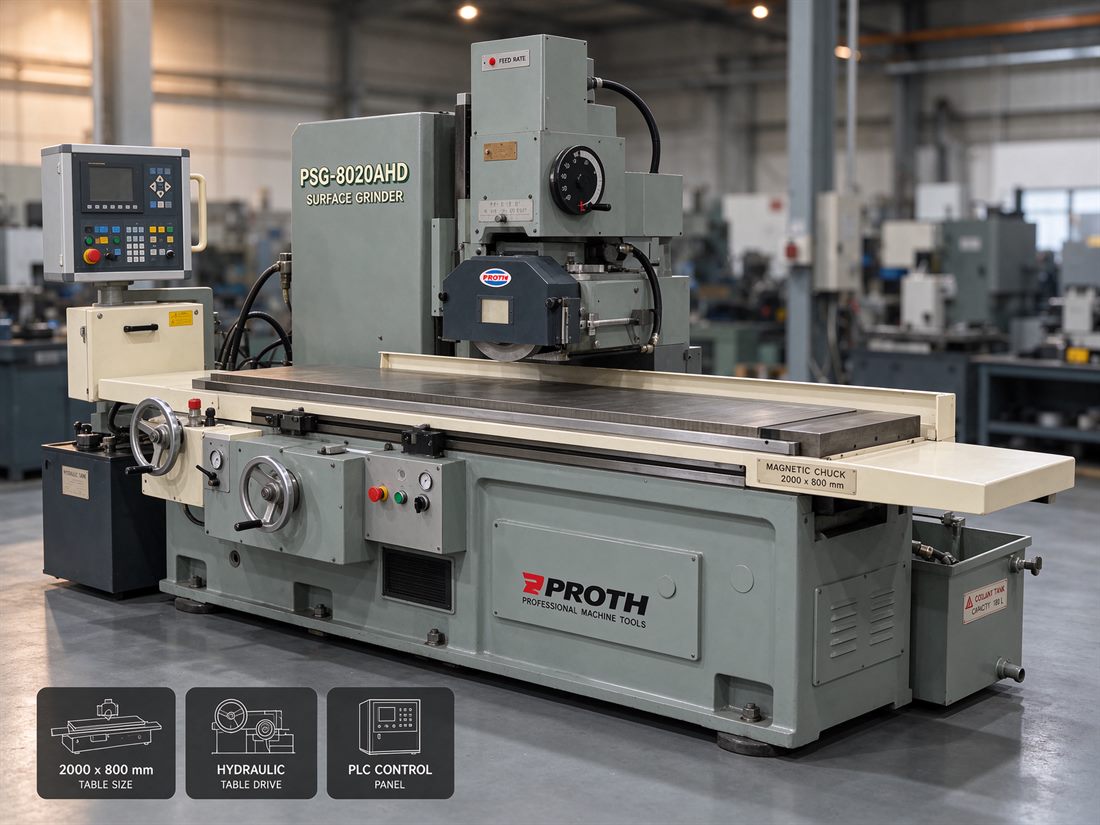
On a machine with a small standard tank — a 30 L tank on a manual machine such as the PSG-618M — the first upgrade is not a separator but a bigger tank and a proper settling zone. On a production machine in the PSG-4080AH class, the separator and paper filter pay for themselves within a year and should be part of the quote, not an afterthought. The coolant nozzle assembly with magnetic separator is the smallest version of that upgrade and fits an existing machine in an afternoon.
FAQ
How often should I change surface grinder coolant?
Every 6–12 months in a filtered, monitored tank; every 1–3 months unfiltered. Change sooner if it smells, the pH drops below 8.5, or parts start rusting.
Does a magnetic separator remove grinding sludge?
It removes ferrous particles down to 5–10 µm, which is most of the mass on steel work. It removes nothing from aluminium, carbide or the abrasive itself, so pair it with settling or a bag filter.
Why is my wheel loading even with clean coolant?
Clean coolant is not the only cause. Check the wheel grade and structure first — a dense fine wheel loads regardless of filtration.
Can I just use a bigger tank instead of a filter?
Partly. A bigger tank with a proper settling zone removes coarse material and is the cheapest first step, but it still returns fines under 20 µm to the wheel.
Bottom line
Filtration is the cheapest reliability upgrade on a surface grinder: a few hundred dollars of separator and a weekly refractometer reading protect wheel life, finish and the ways. Tell us your machine, the material and the weekly hours and we will size the tank and the filtration stage it needs. Ask for a coolant system recommendation.